Since April 2021, all companies in Spain -- regardless of size -- are required to maintain an up-to-date pay register. It's not optional, there are no exceptions based on employee count, and fines for non-compliance can reach 187,515 euros in serious cases. If your company still doesn't have a well-structured pay register, or if you have one but aren't sure it meets all the legal requirements, this article explains exactly what you need and how to get it done.
What the law says: RD 902/2020 and RD 901/2020
Spanish regulations on pay equality are built around two Royal Decrees that work together:
Royal Decree 902/2020 establishes salary transparency obligations. Its goal is to guarantee equal pay between men and women for work of equal value. It requires all companies to maintain a pay register that includes average salary values, pay components, and non-salary benefits, broken down by gender and distributed by professional groups.
Royal Decree 901/2020 regulates equality plans. Companies with 50 or more employees must prepare and register an equality plan that includes a complete pay audit. This plan has a maximum validity of four years and must be registered with REGCON (the Spanish public registry for collective agreements and equality plans).
The combination of both decrees creates a system where salary transparency isn't just an administrative exercise, but a tool for detecting and correcting gender pay gaps.
What the pay register must contain
The pay register must clearly and structurally reflect all salary information for the workforce. The law requires it to include:
Mean and median values. For each professional group, category, or equivalent job position, you must calculate both the arithmetic mean and the median of compensation, separated by gender.
Breakdown by type of compensation. It's not enough to show the total salary. The regulations require separating three categories as per Article 28.2 of the Workers' Statute:
- Base salary. The compensation set per unit of time according to the collective agreement or individual contract.
- Salary supplements. Including personal supplements (seniority, qualifications, languages), position-based supplements (night work, hazard pay, shift work), performance-based (incentives, commissions, bonuses), and overtime.
- Non-salary benefits. Per diems, transportation allowances, meal vouchers, health insurance, pension plans, and similar.
Pay gap by category. When the difference between the average pay of men and women exceeds 25% in any category, the company must include an documented business justification in the register. This justification must be based on criteria unrelated to gender: differences in seniority, different job valuations, individual performance supplements, etc.
The pay component catalog: the foundation of everything
One of the most common mistakes is trying to create the pay register without first having a clear salary concept structure defined. If each contract has salaries defined differently, or if you mix concepts that should be separate, the resulting register will be inconsistent and hard to justify during an inspection.
Standard payroll coding distinguishes between concepts subject to Social Security contributions and exempt concepts:
In the Spanish payroll system, codes 001-199 correspond to items subject to Social Security contributions: base salary, personal supplements, position supplements, incentives, overtime, and extra pay periods.
Codes 200-299 correspond to non-salary benefits, many of which are exempt from contributions up to certain legal limits. For example, in Spain, meal vouchers are exempt up to 11 euros per working day, employee health insurance up to 500 euros annually, or mileage up to 0.19 euros per kilometer.
Having a structured catalog with this coding not only facilitates legal compliance but also simplifies integration with payroll software like A3, Sage, or Nominaplus.
Obligations based on company size
Obligations vary significantly depending on the number of employees:
All companies must maintain a pay register updated annually, accessible to employee representatives, and available for the Labor Inspection.
Companies with 50 or more employees have additional obligations. They must prepare an equality plan that includes a complete pay audit, with an initial assessment, equality objectives, corrective measures, implementation timeline, and monitoring indicators. This plan must be registered with REGCON and has a maximum validity of four years.
Companies with more than 50 employees where the gap exceeds 25% in any category must document that the difference is due to objective criteria unrelated to gender.
How TalentoHQ helps you comply with the regulations
TalentoHQ includes a complete compensation management module designed specifically to meet the requirements of RD 902/2020 and RD 901/2020. You don't need to be an expert in labor law or spend hours creating spreadsheets: the system does the heavy lifting for you. You can see all the tools in detail on our pay equality page.
Preconfigured salary concept catalog
When you turn on the compensation feature, TalentoHQ automatically creates a catalog with over 100 standard salary concepts, organized according to official coding:
- Base salary in its monthly, daily, and hourly variants.
- Personal supplements such as seniority, three-year seniority bonuses (trienios), five-year seniority bonuses (quinquenios), qualification bonuses, language bonuses, and personal pay adjustments (ad personam).
- Position supplements including night work, shift work, hazard pay, arduous work, toxic conditions, responsibility, availability, and holiday work.
- Performance supplements such as incentives, commissions, production bonuses, target bonuses, and profit-sharing.
- Overtime differentiating between regular, emergency overtime (force majeure), holidays, and night shifts.
- Bonus pay periods (pagas extraordinarias) with support for monthly proration.
- Non-salary benefits such as per diems, mileage, meal vouchers, childcare vouchers, health insurance, and pension plans.
Each concept includes its legal category, payment frequency, and whether it's subject to contributions, allowing the legally required breakdowns to be generated automatically.
Exemption limit monitoring
The system knows the legal exemption limits for each non-salary concept and alerts you when an amount exceeds them. For example, if you assign a meal voucher of 15 euros per day, TalentoHQ will indicate that the amount exceeding 11 euros is taxable as employment income. This helps you optimize your employees' flexible compensation without tax surprises.
Automatic pay register generation
With a single click, TalentoHQ generates the annual pay register with all the data required by the regulations:
- Grouping by professional category. The system uses the professional group, job family, and level structure you already have set up in your org chart.
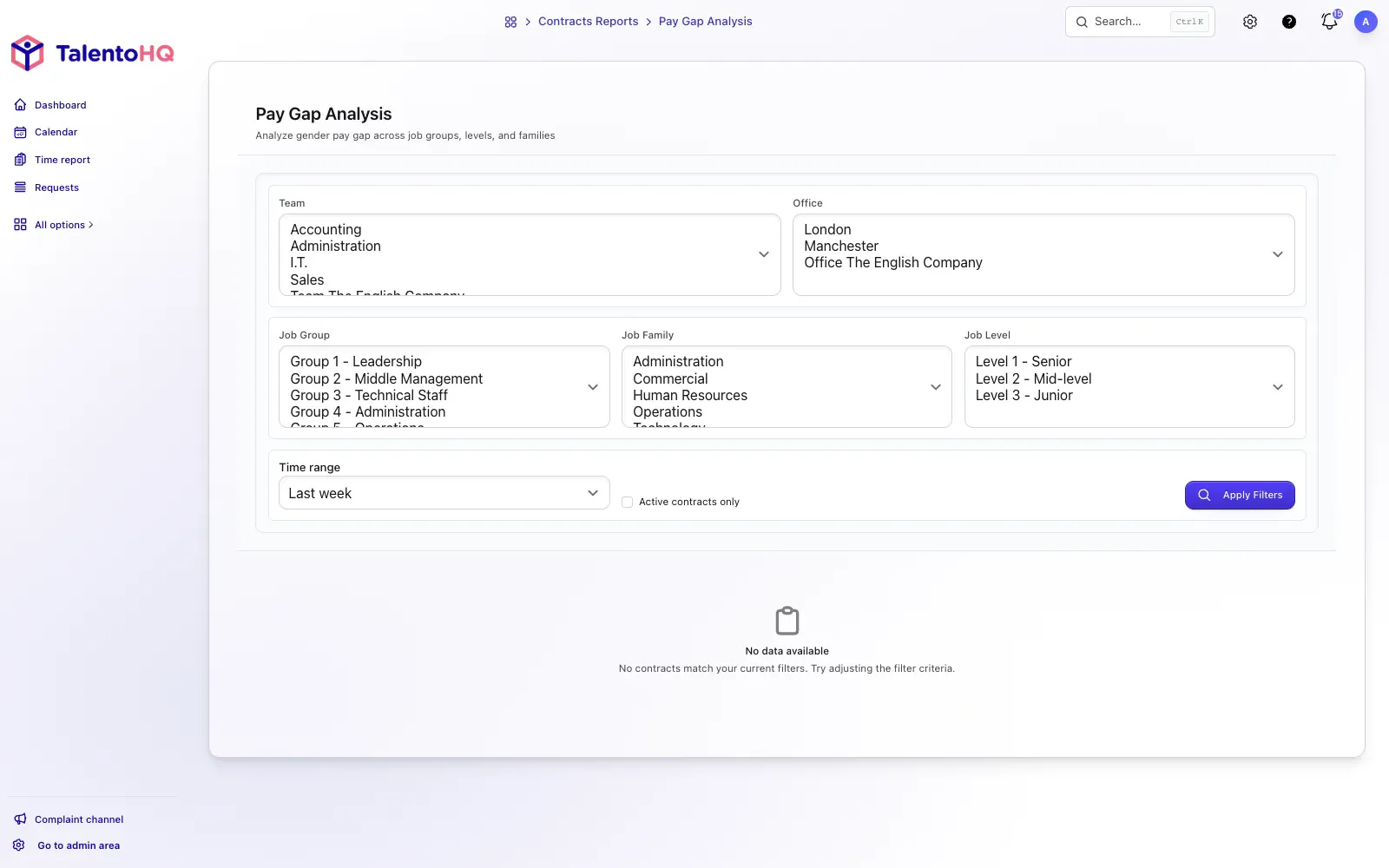
- Mean and median calculations. For each group and each type of compensation (base, supplements, non-salary), it automatically calculates the mean and median values by gender.
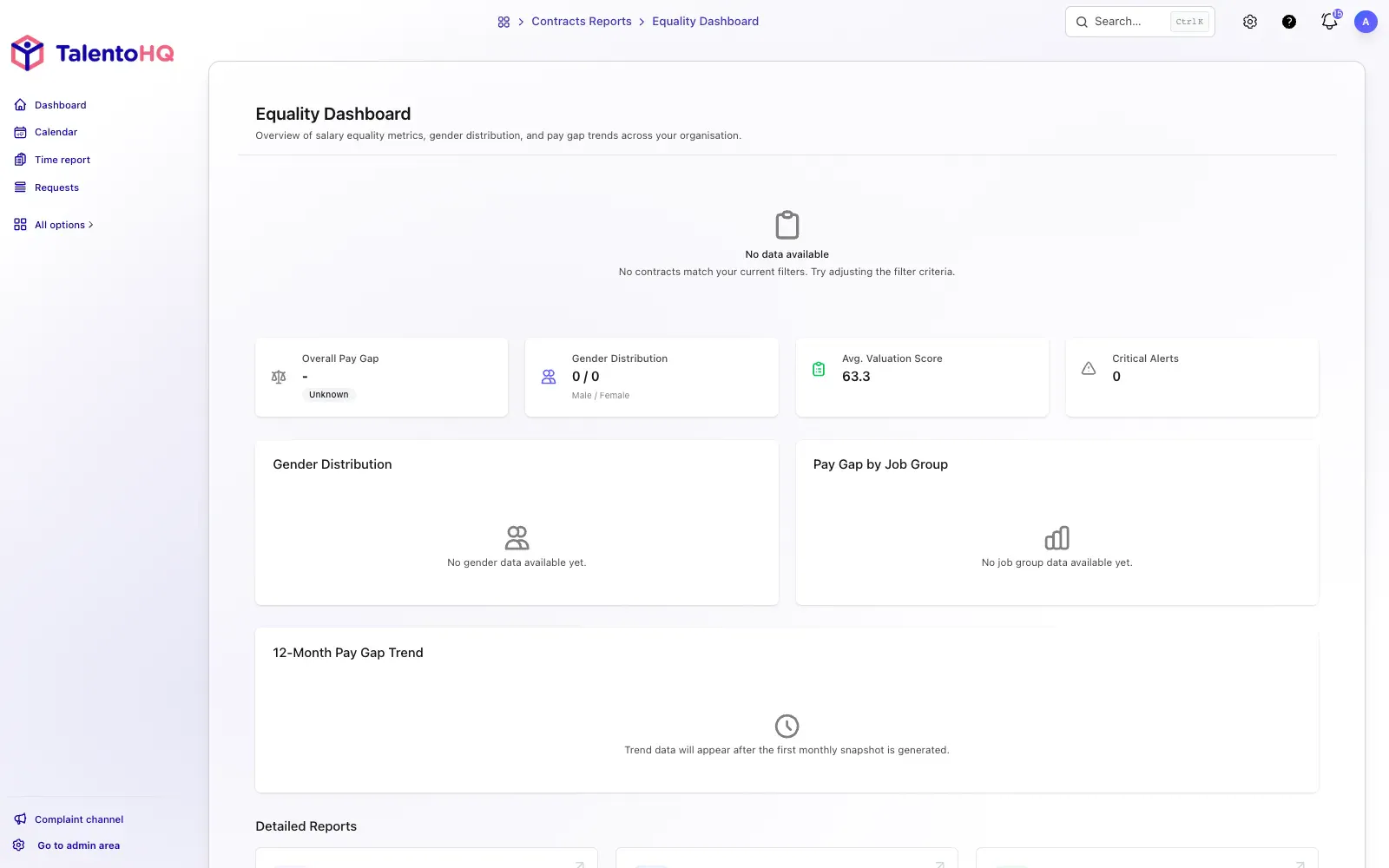
- Gap detection. It identifies categories where the difference exceeds 20% (warning) or 25% (requires justification) and visually flags them in the report.
- Year-over-year history. It keeps registers from previous years so you can demonstrate the progress and corrective measures applied.
Proactive alert system
You don't have to remember when it's time to update the register. TalentoHQ automatically alerts you when:
- The register is more than 10 months old and it's time to renew it.
- A gap exceeding the legal threshold is detected in any category.
- The documentary justification for a gap that requires one is missing.
- The equality plan is about to expire (companies with 50+ employees).
- It's time to conduct the pay audit.
Job position valuation
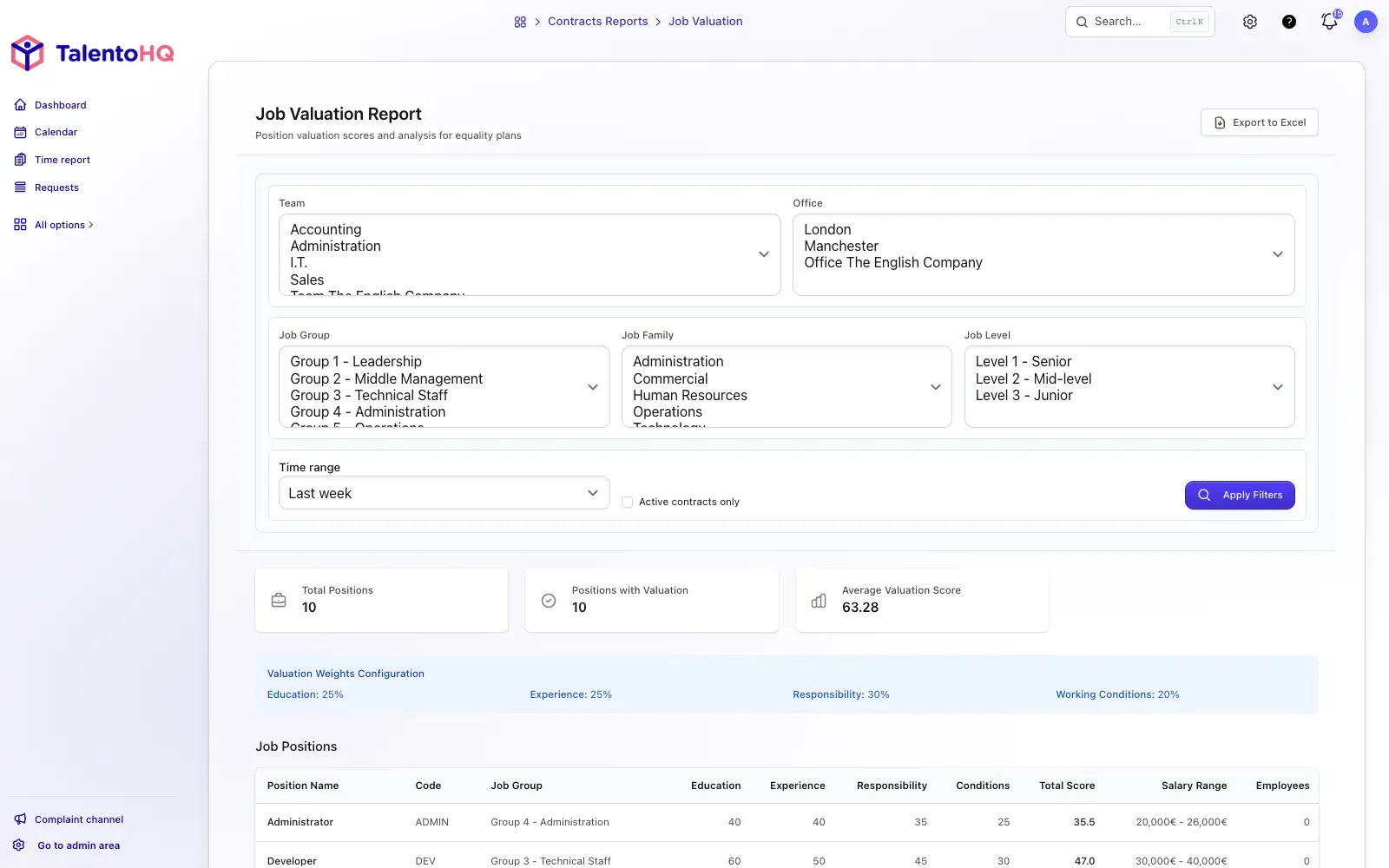
To justify pay differences between positions, the law requires that the valuation be based on objective criteria. TalentoHQ includes a scoring system with four factors, as established by Article 28.1 of the Workers' Statute:
- Education. Level of education and qualifications required for the position.
- Experience. Years of professional experience required.
- Responsibility. Level of autonomy, team supervision, and decision-making.
- Working conditions. Arduousness, hazardous conditions, physical environment, and effort required.
This objective valuation is the basis for demonstrating that two positions with different pay actually have different value for the organization.
Benefits of digitizing compensation management
Beyond legal compliance, properly structuring salary information has important operational advantages:
Internal transparency. Employees can understand exactly how their compensation is composed, what supplements they receive, and why. This reduces queries to the HR department and improves the perception of fairness.
Inspection readiness. When the Labor Inspection requests the pay register, you can generate it in seconds with all the required information. There's no need to gather data from multiple sources or improvise justifications.
Foundation for negotiations. Having a clear salary structure makes conversations about salary reviews, promotions, and new hires easier. You can objectively compare a position's compensation with similar ones in the organization.
Payroll integration. Standard coding allows you to export data to your payroll software or import information from it, avoiding duplications and transcription errors.
Early problem detection. The alert system lets you identify pay gaps before they become a legal or workplace climate issue.
Penalties for non-compliance
The Law on Infractions and Penalties in the Social Order establishes significant fines for companies that fail to comply with pay equality obligations:
- Minor infractions (up to 7,500 euros): not having an updated pay register or not providing it to employee representatives.
- Serious infractions (from 7,501 to 37,500 euros): gender-based pay discrimination, failure to prepare the equality plan when required.
- Very serious infractions (from 37,501 to 225,018 euros): repeated pay discrimination or discrimination affecting a significant number of workers.
Additionally, penalized companies may lose access to Social Security contribution discounts and be excluded from public administration contracts.
How to get started
Implementing a compensation management system doesn't have to be complicated. With TalentoHQ, the process is straightforward:
- Activate the compensation module in your account settings or contact our support department to have it activated.
- Review the concept catalog and add or modify any that are specific to your collective agreement.
- Assign salary concepts to each contract, breaking down the compensation into its components.
- Generate your first pay register and review whether there are gaps that need attention.
- Set up alerts so the system notifies you of relevant deadlines and thresholds.
The entire process can be completed in an afternoon, and from there the system keeps the information updated automatically.
Conclusion
The pay register isn't just a legal obligation: it's a tool for ensuring pay equity in your organization and protecting yourself against potential claims. Having a clear salary concept structure, with the correct coding and the breakdowns required by law, lets you comply with regulations without spending hours on administrative tasks.
You can book a demo or start a 14-day trial to see how pay concepts feed the salary register required by RD 902/2020. For the full pay-equality workflow, visit the pay equality page.
Legal references:
- Royal Decree 902/2020 on equal pay between women and men
- Royal Decree 901/2020 regulating equality plans
- Article 28 of the Workers' Statute on equal pay regardless of gender