Know your team and help it grow: skills management that drives results

Do you know exactly what skills and certifications each person on your team has? Most companies don't have a clear picture. And that means when a new project or an inspection comes up, time is wasted looking for information that should be accessible in seconds. The talent is already in your organization, but without a system to document it, it's invisible.

Most companies only review their team's skills when something expires or when an inspection demands it. However, when you have real visibility into your team's competencies, decisions improve significantly.

In this article, we'll look at how an up-to-date skills map transforms the way you develop your team: from project assignments to internal promotions, including a renewal calendar that becomes a true growth roadmap.

Why you need an up-to-date talent map

Most SMEs manage skills reactively. Someone asks who has a forklift license, they search through a spreadsheet, and in the best case, they find an up-to-date answer. A certificate expires, an internal alarm goes off (or doesn't), and it's handled at the last minute. The information exists, but it's scattered across spreadsheets, emails, and the memory of team leaders.

A competency map completely changes that dynamic. When you have a centralized, up-to-date view of what each person can do, you can:

  • Discover hidden strengths. It's common for your team to already have valuable competencies that nobody has registered in a searchable system. According to data from LinkedIn, companies that prioritize internal mobility retain their employees nearly twice as long.
  • Spot gaps early. If you see that only two people out of a team of ten have a critical certification, you can plan training before the problem shows up in the middle of a project.
  • Make data-driven decisions, not gut-feel ones. Team skills management stops being an approximate perception and becomes a strategic tool with reliable information.

This isn't about bureaucracy or checking a box for the sake of it. It's about having the information you need to make better decisions about your team, at the moment you need it.

Four decisions that improve when you know your team's skills

Good employee training management isn't just about offering courses. It's about knowing what each person and each team needs, and acting accordingly. When you have that visibility, everyday decisions improve noticeably.

Project assignments. Instead of assigning people by availability or habit, you assign by actual competency. If you need someone with a data protection certification for a project, you search the system and find them in seconds. No asking three managers or digging through files.

Targeted training. The training budget stops being distributed evenly or on a first-come-first-served basis. If you know a team has a specific gap in a skill needed for the next quarter, you can invest right there. A company training plan that responds to real needs has a measurable impact. Plus, when you identify that gap in TalentoHQ, you can create the training event directly, assign it to the team, and when completed, the skill is granted automatically. The entire process is connected in a single flow.

Internal promotions. Who is ready to take the next step? Without a competency map, the answer usually relies on seniority or subjective perception. With clear data on skills, experience, and completed training, you can identify internal candidates with objective criteria. Employee professional development stops being a vague conversation and becomes a path with visible signposts.

Renewal planning. Every certificate that expires can be either an emergency or a planned milestone. If you manage renewals as part of a development calendar, they stop being a source of stress and become opportunities to update knowledge and strengthen competencies.

If any of these situations sound familiar, you can see how employee skills management works in TalentoHQ and check how it translates into practice.

From expiry calendar to growth roadmap

There's a significant difference between managing renewals reactively and managing them as part of a development strategy. The nuance lies in how you look at the calendar.

When an expiry date is just a deadline to meet, the management is reactive: someone spots the expiry -- if they spot it at all -- a slot is found for renewal, it's resolved urgently, and the case is closed. The result is that renewals are always handled with urgency, disrupt operations, and add no value beyond regulatory compliance.

TalentoHQ calendar with certificate renewals and planned training events

But when that same date is part of a competency map, the reading changes. Each renewal is an opportunity to update training levels, to evaluate whether that skill is still relevant for the role, or to extend the certification to more team members. Automatic notifications stop being an alarm and become a planning window: "in 60 days we have three renewals due -- should we organize a group training session?"

At a company level, this approach enables something few SMEs do well: strategic competency planning. If you can see at a glance which certifications expire in the next six months, in which teams and which offices, you can coordinate training, redistribute budget, and anticipate hiring needs. That's strategic talent management, not just administrative management.

How TalentoHQ gives you that visibility

Everything above makes sense as an approach. The key question is: how do you implement it without adding operational burden to the team? This is where TalentoHQ comes in.

TalentoHQ's talent management module includes a complete skills and certificate tracking system designed to give you real visibility without additional manual work.

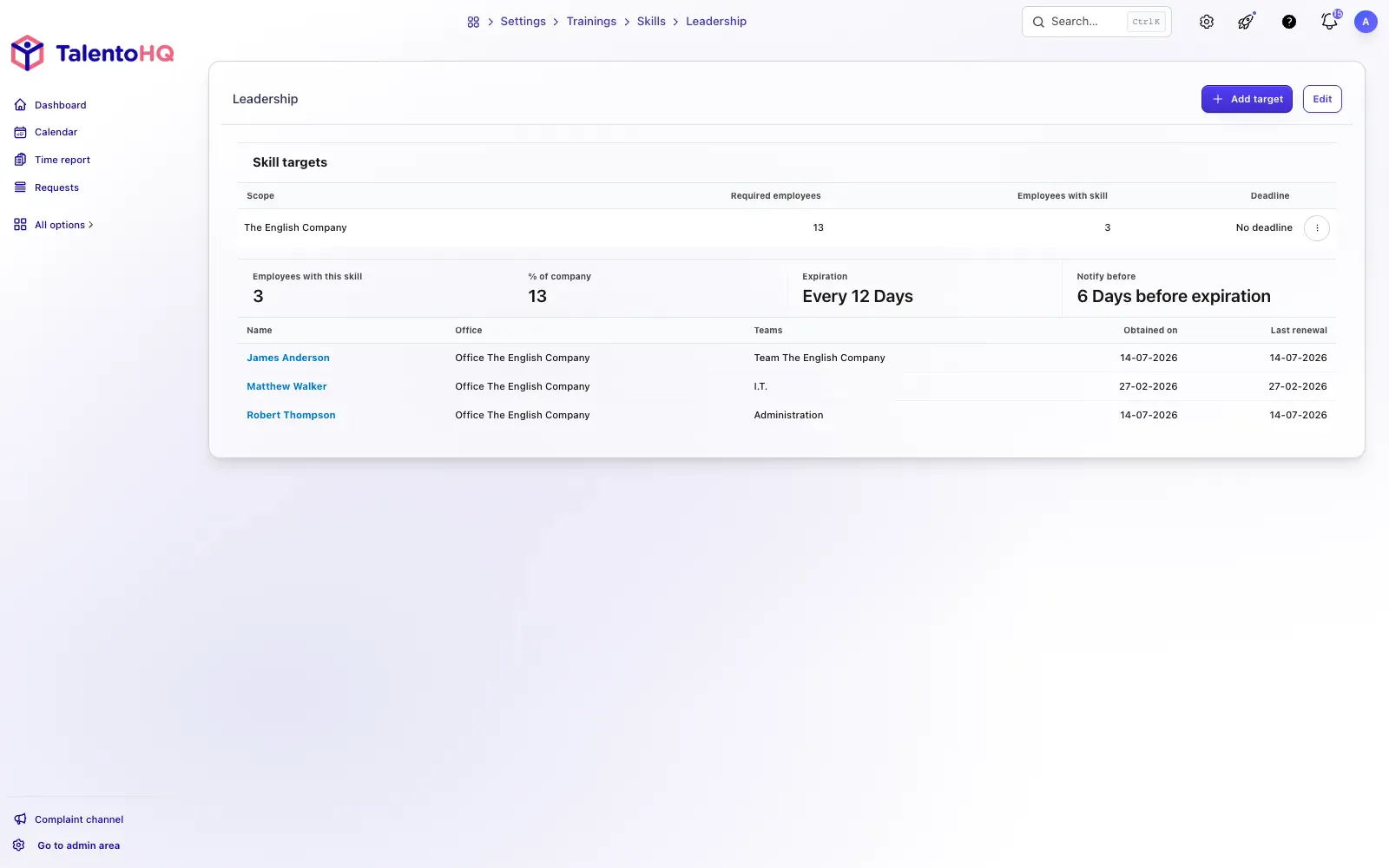
Skills objectives panel in TalentoHQ with team compliance percentages

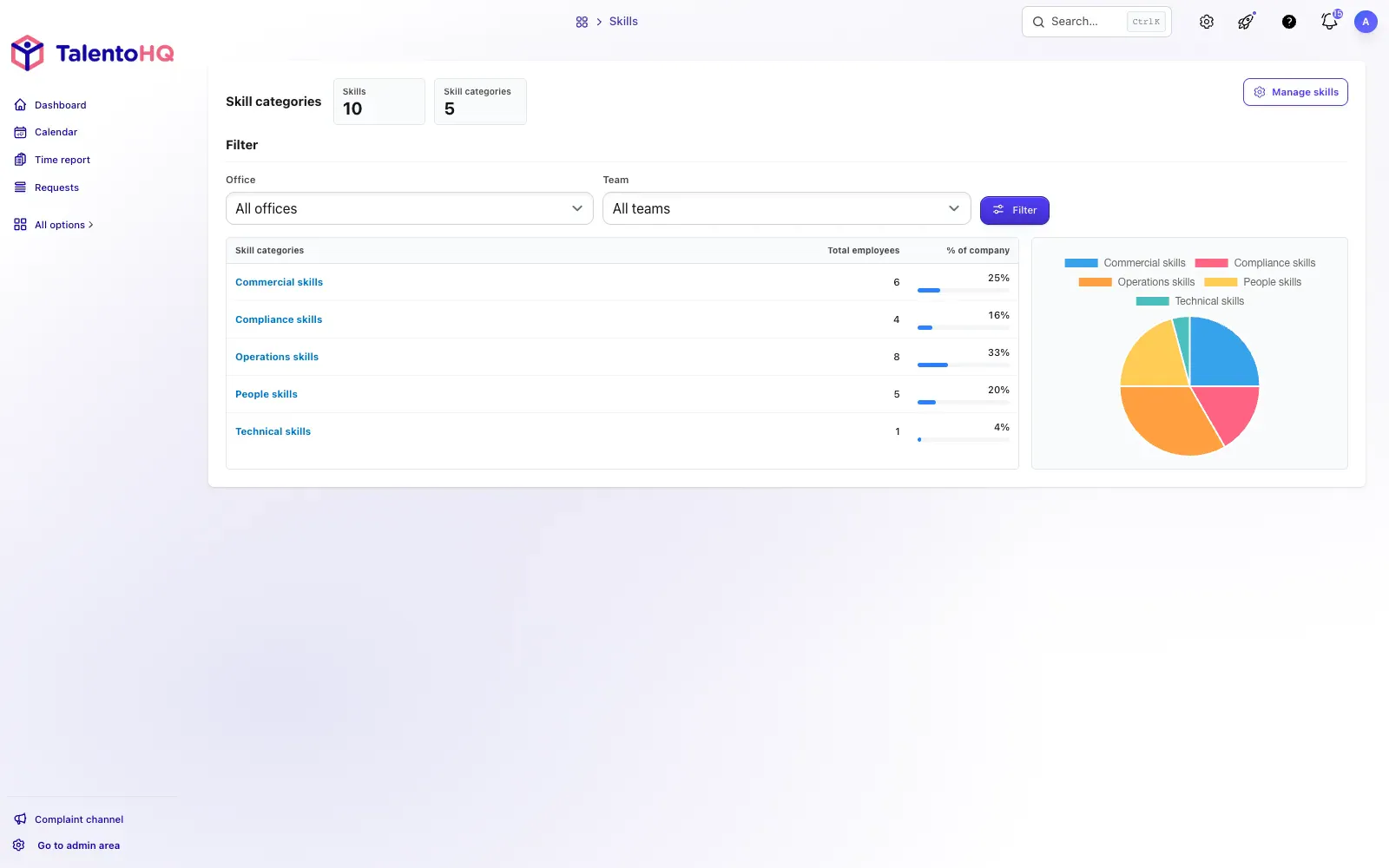
Skills panel with categories and objectives

Each skill is organized by categories (safety, languages, technical, industry certifications...) and you can define compliance objectives by company, office, or team. The system shows you in real time what percentage of your workforce has each competency up to date.

Automatic expiry tracking

When you register a skill with a validity period, TalentoHQ calculates the expiry date and schedules notifications automatically. You define the alert window (30, 60, 90 days in advance) and the system takes care of the rest: emails to the manager, alerts on the platform, and an automatic entry on the calendar.

Automatically generated calendar events

Each certificate with an expiry date appears on the TalentoHQ calendar. Without opening any spreadsheet, you can see at a glance which renewals are coming up in the next weeks or months.

Compliance objectives by team and office

Need 100% of your construction team to have their occupational health and safety certification up to date? Define the objective, and the system alerts you if compliance drops below the level you've set. This feature is especially useful if you manage multiple offices or dispersed teams.

Audit-ready reports in seconds

All information is centralized: who has which certification, when they got it, when it expires, and when it was renewed. For an inspection, you generate a complete report with a single click. If you already have in mind the double cost of managing certificates manually, you know exactly what you want to avoid.

Internal training connected to skills

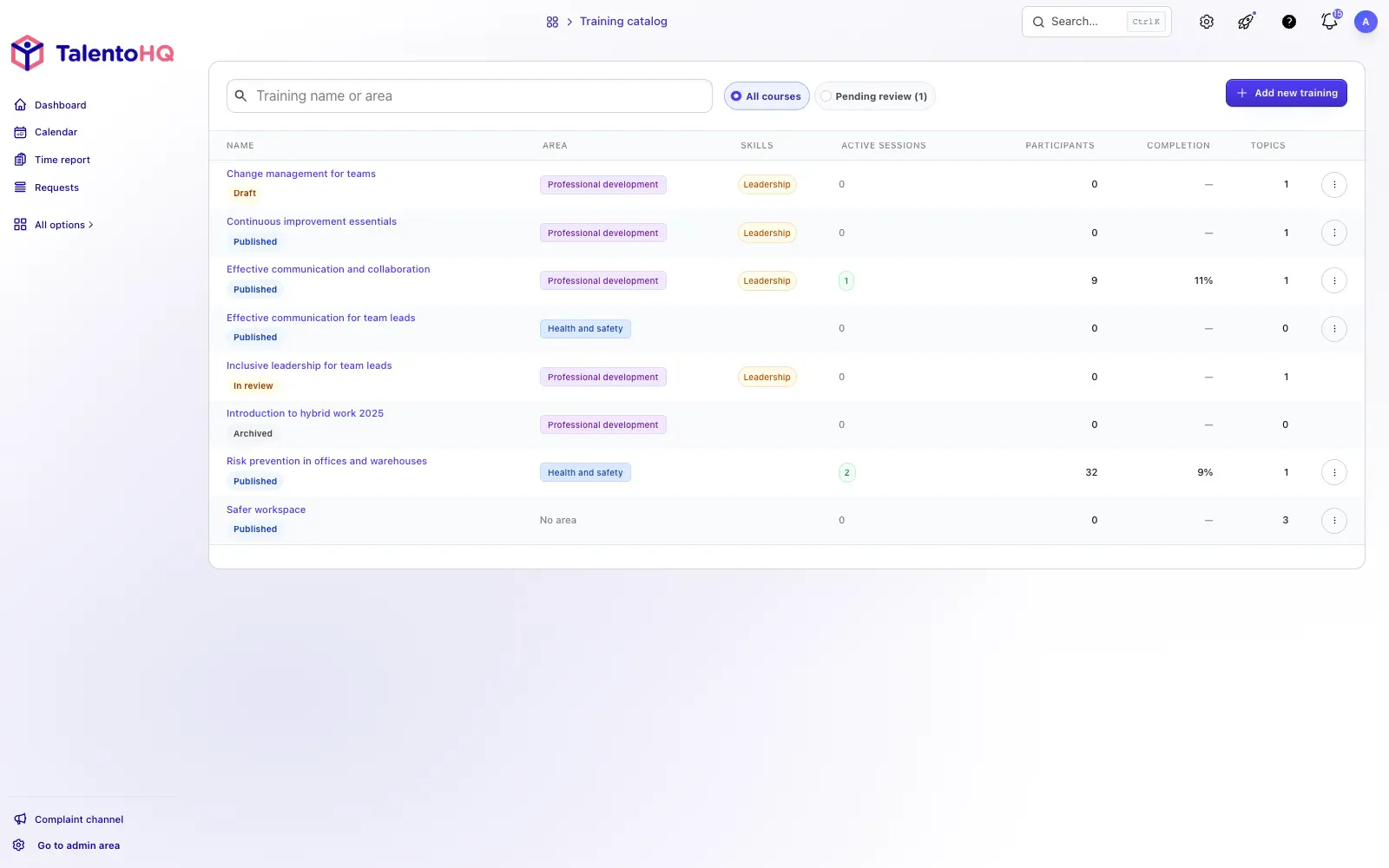
TalentoHQ includes an integrated LMS platform where you can create complete courses organized by topics, lessons, and content blocks. This isn't about sharing a static document with no tracking: you can design structured training with ordered progression.

Each course is delivered through events with a date, capacity, and format (in-person, online, or hybrid). Employees enroll, complete the content at their own pace, and if configured, must pass an assessment before earning the certification.

TalentoHQ LMS platform with courses, lessons, and progress tracking

The differentiating value is clear: when an employee completes a training, the associated skills are assigned automatically. No need to update spreadsheets or do additional manual work. The skill appears on their profile, expiry dates are calculated, and team compliance objectives are updated on their own. All in a single flow.

Training linked to occupational health and safety can be marked as mandatory, so it receives priority in tracking and renewal alerts. And all of this is complemented by performance evaluations to close the complete professional development cycle.

Conclusion

Skills management isn't administrative work. It's strategy. When you know what your team can do, you make better decisions: you assign projects with purpose, invest in training where it truly matters, promote based on data, and plan renewals as growth milestones.

The change doesn't require months of implementation or a technical team. With TalentoHQ, you can have complete visibility into your team's competencies from day one.

Try TalentoHQ free for 30 days and see what your team is truly capable of. No credit card, no commitment.