Your company has grown, your team too, but performance evaluations are still a spreadsheet that someone fills out at the end of the year. If that sounds familiar, you're not alone: most SMEs are still stuck in an annual evaluation model that generates more frustration than results.
The problem isn't evaluating -- it's how you evaluate. A well-designed evaluation process doesn't just measure performance: it aligns expectations, drives professional development, and strengthens the relationship between managers and teams. In this article, you'll discover:
- Why traditional annual evaluations fail in SMEs
- How to design a continuous, realistic evaluation cycle
- What elements an effective evaluation should include
- How to implement the entire process with digital tools, step by step
Why annual evaluations don't work in SMEs
The annual evaluation model was born in large corporations with dedicated HR departments. Transferring it directly to an SME with 20, 50, or 100 employees creates predictable problems.
The first is the recency effect: when you evaluate once a year, you only remember the last two or three months. The excellent work from March gets buried under November's mistake. That's neither fair nor useful for anyone.
The second is the temporal disconnect. If an employee needs to improve something in February and doesn't receive feedback until December, you've lost ten months during which they could have corrected course. In an SME, where each person has a proportionally greater impact, that time is precious.
And the third is the administrative burden. When everything piles up in a single moment of the year, managers perceive it as a bureaucratic chore. They fill out forms in a rush, score without reflecting, and the process loses all its value.
Continuous evaluation: a model that fits the SME
The alternative isn't to stop evaluating, but to evaluate more frequently and with less formality. A continuous evaluation model combines three elements that complement each other:
- Regular feedback. Brief, frequent conversations between manager and employee about achievements, challenges, and next steps. You don't need a 30-question form: sometimes a 15-minute meeting every two weeks is enough.
- Evolving objectives. Instead of setting annual goals and reviewing them in December, establish quarterly objectives that adjust as the business evolves. OKRs (Objectives and Key Results) are a particularly useful methodology for this.
- Periodic formal evaluations. Two or three structured evaluations per year provide the formal record you need without the overload of doing everything at once. Tools like TalentoHQ let you configure recurring evaluations (quarterly, semi-annually, or whatever cadence you prefer) and the system automatically creates each iteration with its own responses and results.
This model has an additional advantage in SMEs: since teams are smaller and relationships more direct, frequent feedback integrates naturally into day-to-day work. You don't need to create a complex corporate structure; you need the right tools and a clear process.
The five elements of an effective evaluation
Regardless of frequency, a performance evaluation needs to include certain elements to be truly useful.
1. A well-defined competency framework
Competencies are the skills and behaviors you want to measure for each role. We're not talking about generic lists like "teamwork" or "proactivity," but specific competencies tied to the role: a salesperson needs different competencies than a developer or an operations manager.
Ideally, competencies are organized into two categories: performance (what the person delivers today) and potential (their capacity for growth). This distinction allows you to cross both axes and make more informed decisions about promotions, training, or team reorganization.
Each competency should have a clear rating scale. A 5-level scale works well for most SMEs: from "needs significant improvement" to "exceptional, a reference for the team." Additionally, you should define a target level per role: you don't expect the same level of leadership from a junior technician as from a department head.
2. Objectives aligned with strategy
Every employee should clearly understand how their work contributes to the company's goals. OKRs are a methodology that works especially well in SMEs because they're specific, measurable, and reviewed frequently. A good objective combines ambition with realism: challenging enough to motivate, achievable enough not to frustrate.
3. Multiple perspectives, not just the manager
An evaluation based solely on the direct manager's opinion provides an incomplete picture. A salesperson may perform well in sales but create friction with the operations team. Without additional perspectives, that goes unnoticed until it becomes a serious problem.
360-degree feedback combines several sources: the employee's self-assessment (to reflect on their own performance), the direct manager's evaluation, the team lead's evaluation (if different from the direct manager), and even peers' input. You don't need to ask the entire company for feedback: 3 or 4 people who work directly with the person being evaluated is enough.
The key is being able to compare these perspectives. When an employee's self-assessment differs significantly from their manager's rating, there's an important conversation to be had.
4. Clear results visualization
Evaluation data is only useful if it can be interpreted quickly. Two visualizations are especially valuable for an SME:
- Radar chart (spider chart). Shows all of an employee's competencies on a radial chart, with a line for each evaluator and a reference line marking the target level for the role. At a glance, you see where they excel and where they need development.
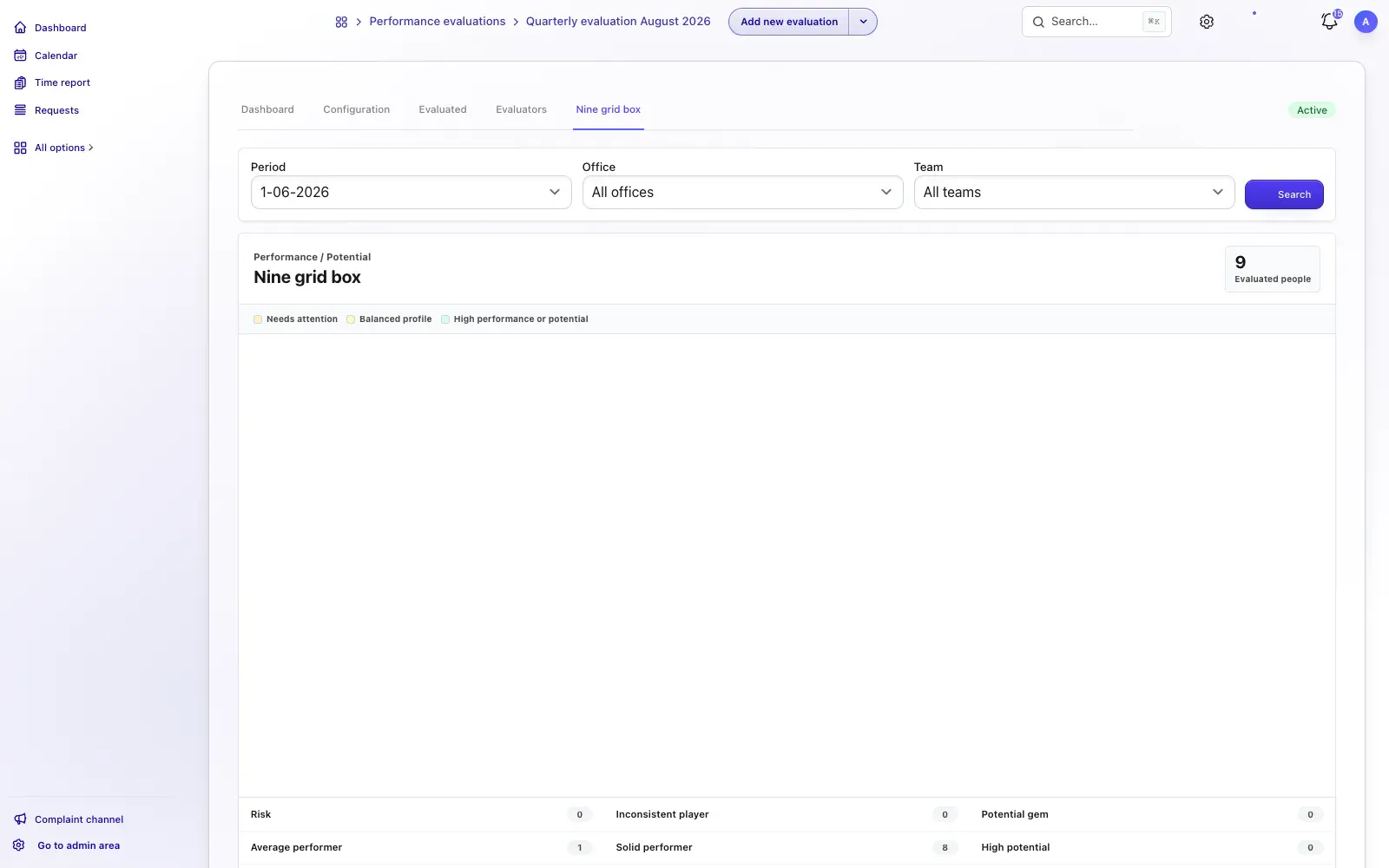
- Talent matrix (nine-grid box). Crosses performance (X-axis) with potential (Y-axis) and positions each employee in a nine-cell grid. From "at risk" (low performance, low potential) to "star" (high on both). This team view helps you identify who to promote, who to train, and where to focus retention efforts.
5. A concrete action plan
An evaluation without an action plan is an incomplete exercise. Each evaluation should end with clear commitments: what the employee will improve, what resources they need, what training could help, and when progress will be reviewed.
How to implement evaluations with TalentoHQ
TalentoHQ includes a complete talent management module designed so that an SME can configure and run performance evaluations without the complexity of tools built for large corporations. Let's see how each element we've described fits into the platform.
Ready-to-use and customizable competencies
When you create your account, TalentoHQ includes 22 predefined competencies, already organized into the two categories we mentioned: performance (adaptability, leadership, results orientation, time management, teamwork) and potential (communication, creativity, initiative, problem-solving).
You can use these competencies directly or customize them: rename, add new ones, remove those that don't apply to your company, and adjust the rating scale. The important thing is that you don't start from scratch. Each competency is rated on a 0-to-4 scale with descriptive labels (from "needs improvement" to "exceptional"), making it easy for evaluators to score consistently.
You can also define target levels by professional category. For example, you might require a level 3 in leadership for managers but not for a technician. These targets appear as a reference line on the radar charts, making the comparison immediate.
Six types of evaluators for complete feedback
Where many tools are limited to the manager's evaluation, TalentoHQ supports six types of evaluators that you can freely combine:
- Self-assessment. The employee evaluates their own performance, encouraging reflection and generating a valuable comparison point with other perspectives.
- Direct manager. The main evaluation, based on daily observation of the work.
- Team lead. Useful in matrix organizations or when the team lead isn't the same as the direct manager.
- Office manager. An additional location-based perspective, especially useful if you have employees at multiple workplaces.
- Specific person. Allows a specific stakeholder (a project director, a manager from another department) to participate in the evaluation.
- Peer evaluation. You can configure each employee to evaluate a random peer or all members of their team.
For an SME just starting out, the combination of self-assessment + direct manager is enough. Once the process is running smoothly, you can add peer evaluation for a complete 360-degree view.
Automatic questions based on the role
This is one of the details that saves the most time. When you activate an evaluation, TalentoHQ automatically generates the rating questions based on the competencies assigned to each employee's professional category. If a manager has 10 competencies with a defined target level and a technician has 7, each will receive exactly the questions that correspond to them. You don't need to create different forms for each role: the system handles it.
You can also add custom questions if you need to evaluate specific aspects of a project or a particular period.
Visual results that drive decisions
Once evaluators complete their responses, TalentoHQ automatically generates the two types of visualization we mentioned:
- Radar charts per employee. Each axis represents a competency, with overlapping lines for each evaluator (self-assessment, manager, peers) and the target level reference line. Differences between perspectives are immediately visible: if the employee rates themselves high in communication but their manager sees it as low, there's your starting point for the development conversation.
- Nine-grid box talent matrix. An overview of your entire team crossing performance with potential. You can filter by office, team, or manager to analyze specific segments. "Star" employees (high performance, high potential) are your retention priority; those "at risk" need an improvement plan or a role change.
If you need a more detailed analysis, you can export all data to Excel to cross-reference information with other business metrics.
If you want to see how it works in practice, you can book a demo.
How to get started: step by step
Implementing an evaluation process from scratch can seem overwhelming, but it doesn't have to be. Here's a realistic roadmap for an SME:
- Set up your competency framework. Review the 22 competencies TalentoHQ includes by default and adjust them to your reality. Remove those that don't apply, rename those that need adapting, and define target levels for each professional category (technician, manager, director, etc.).
- Create your first evaluation. Start with something simple: an evaluation with self-assessment and direct manager evaluation. Select the participants (you can filter by team, office, or manager), set the start and close dates, and enable notifications so each evaluator receives an alert when it's their turn.
- Communicate the process to the team. Explain what will be evaluated, why, and how the results will be used. Managers should understand that the goal is to develop, not to judge. Each person should know they'll receive their self-assessment and then have a conversation with their manager.
- Review the results and take action. Use radar charts for individual conversations and the talent matrix for team decisions. Identify patterns: if several people score low on the same competency, maybe you need group training. If a star employee isn't getting enough challenges, it's time to discuss their career plan.
- Adjust and repeat. After the first cycle, gather feedback from managers and employees. Were the competencies relevant? Was the frequency right? Configure the next evaluation as recurring (quarterly or semi-annually) so the system launches it automatically.
Benefits for your SME
A well-implemented evaluation process has a direct impact on metrics that matter:
- Talent retention. Employees who receive regular feedback and see growth opportunities have fewer reasons to look elsewhere. In a market where 8 out of 10 SMEs struggle to find and retain talent, this makes a difference. With the talent matrix, you can identify your star employees before someone else does.
- Aligned productivity. When each person knows exactly what's expected of them and how they contribute to the team, productivity multiplies naturally. Target levels per competency make those expectations explicit and measurable.
- Evidence-based decisions. Promotions, salary increases, and training needs stop being based on gut feelings and are supported by real performance data accumulated over time. The Excel export lets you cross-reference this data with the mandatory pay register to ensure pay equity.
- Work environment. Well-done evaluations build trust. The employee knows their work is recognized and they have a clear development path. You can complement evaluations with workplace climate surveys to measure the real impact on team satisfaction.
Conclusion
Designing an effective performance evaluation process in your SME doesn't require a ten-person HR department or complex enterprise software. It requires clarity in what you measure, frequency in feedback, and a tool that simplifies the management.
With a customized competency framework, multiple evaluation perspectives, and visualizations that turn data into decisions, your team won't just know what's expected of them: they'll have the tools to grow within your company. And in an SME where every person counts, that's what transforms a group of employees into a committed team.