
Companies that actively listen, analyze the feedback they receive, and apply continuous improvements are the ones that manage to retain their team, increase customer satisfaction, and stand out in the market.
One of the most effective methodologies for measuring this satisfaction is the Net Promoter Score (NPS), a direct system widely used around the world. TalentoHQ, as an all-in-one HR and talent management platform, has integrated a feature that lets you create unlimited NPS surveys, both internal and external, with the option to conduct them anonymously and analyze results in an intuitive dashboard.
1. What is NPS and why is it so relevant?
The Net Promoter Score is an indicator that measures the loyalty of employees, customers, or users toward a company, brand, product, or service.
Its simplicity and effectiveness have made it a standard across multiple industries.
The key question in an NPS survey is:
"On a scale of 0 to 10, how likely are you to recommend our company/product/service to a friend or colleague?"
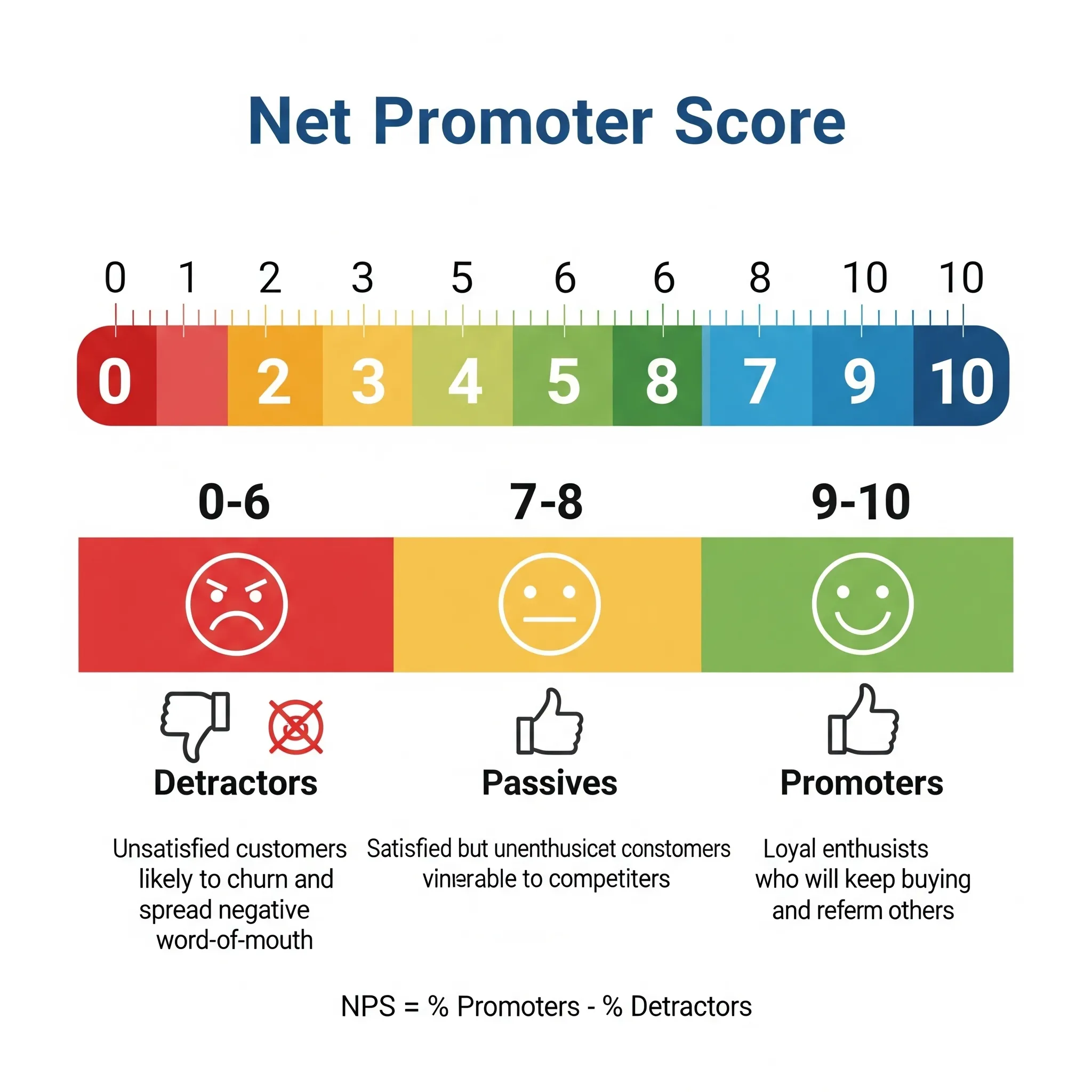
Based on the responses, respondents are classified into three groups:
| Category | Score (0-10) | Description | Recommended actions |
|---|---|---|---|
| Promoters | 9-10 | Highly satisfied, actively recommend. | Foster their loyalty, ask for testimonials, incentivize them as ambassadors. |
| Passives | 7-8 | Satisfied but neutral; could switch. | Understand what's missing for them to become promoters. |
| Detractors | 0-6 | Dissatisfied, can negatively affect reputation. | Analyze causes and take immediate corrective action. |
The NPS calculation is straightforward:
NPS = % Promoters - % Detractors
The result can range from -100 to +100. A high value indicates a very positive perception, while a low or negative one is a warning sign.
2. Benefits of NPS internally
Internally, NPS is a key tool for understanding team satisfaction and engagement.
| Aspect | Internal NPS | External NPS |
|---|---|---|
| Objective | Measure team satisfaction and engagement. | Measure customer/visitor satisfaction and loyalty. |
| Participants | Employees. | Customers, users, or general public. |
| Benefits | Talent retention, improved workplace climate. | Customer loyalty, detection of areas for improvement, growth in referrals. |
| Frequency | Quarterly or biannual. | After key interactions or on an ongoing basis. |
2.1. Understanding the work environment
A positive internal NPS reflects a healthy work environment, while a low result signals the need to take action.
Example:
If 60% of employees are promoters, 25% passives, and 15% detractors, the NPS would be:
60 - 15 = +45 (a good score, but with room for improvement).
2.2. Retaining talent
The feedback collected helps detect issues that could lead to the departure of valuable employees.
2.3. Fostering communication
NPS surveys, especially anonymous ones, allow employees to express themselves honestly, providing valuable information for management.
3. Benefits of NPS externally
On the commercial side, NPS lets you understand the perception of customers, users, or visitors.
3.1. Diagnosing the customer experience
Measures satisfaction in a clear and comparable way over time.
3.2. Improving products and services
Comments associated with scores let you know what works and what doesn't.
3.3. Loyalty and growth
Promoters don't just recommend -- they also buy more and stay longer as customers.
4. The importance of anonymous surveys
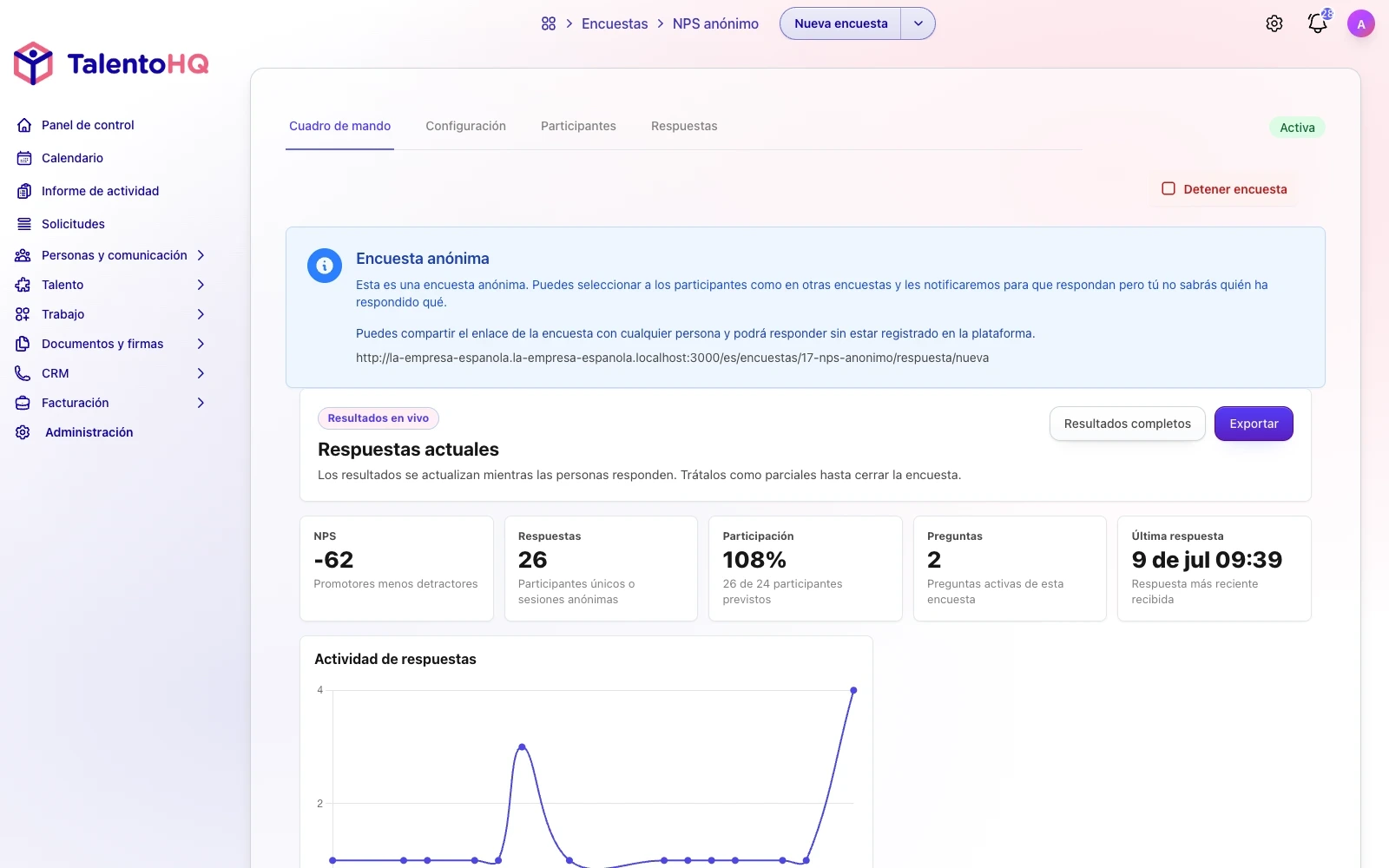
TalentoHQ allows you to conduct anonymous surveys, which encourages honesty and transparency.
- Internally: Employees can speak without fear of retaliation.
- Externally: Customers express their opinions more openly and honestly.
This generates more reliable and useful data for decision-making.
Public NPS survey page - TalentoHQ
5. How TalentoHQ optimizes NPS survey management
5.1. Unlimited creation
No limit on the number of surveys, allowing you to measure satisfaction at different times and in different contexts.
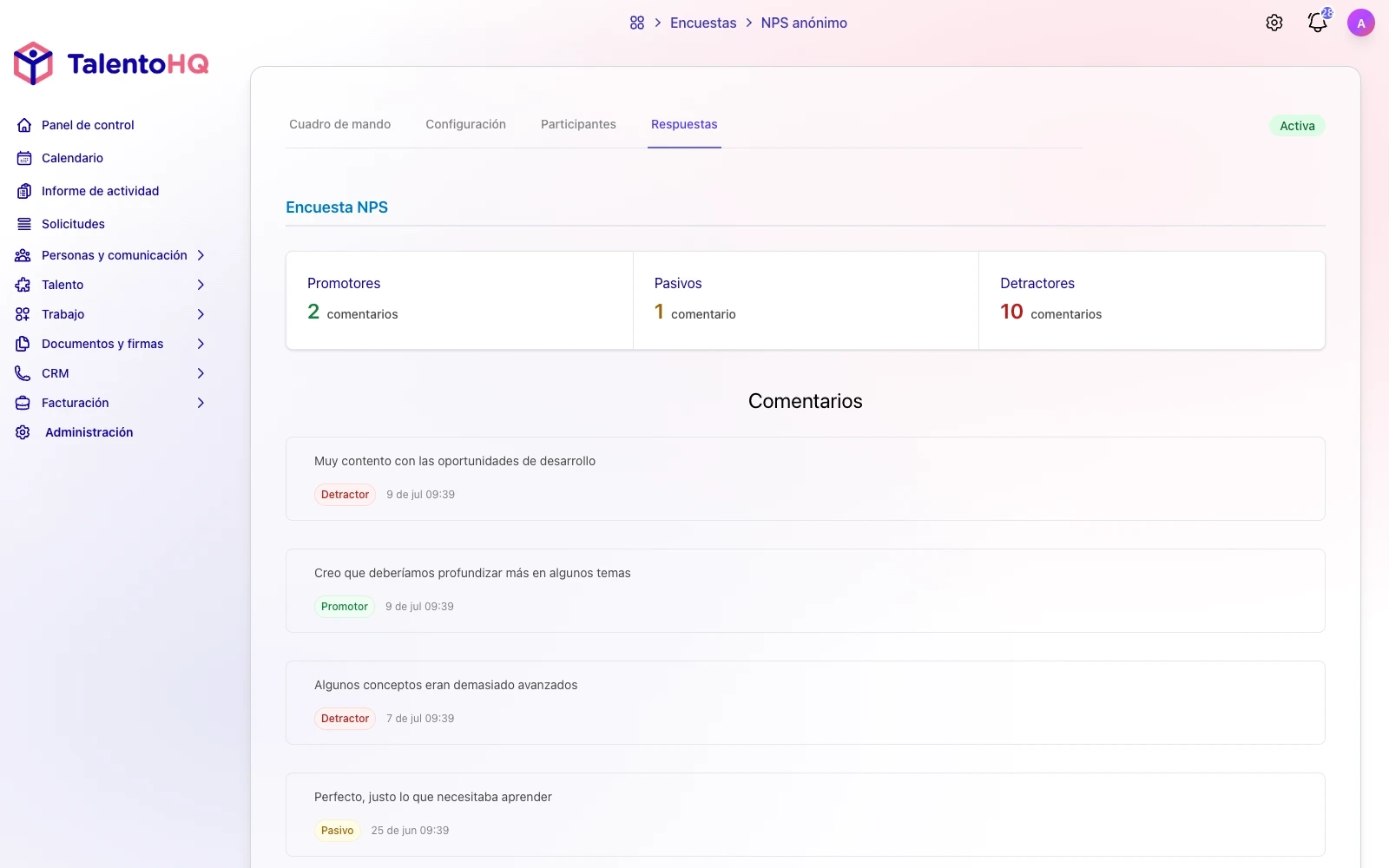
5.2. Visual dashboard
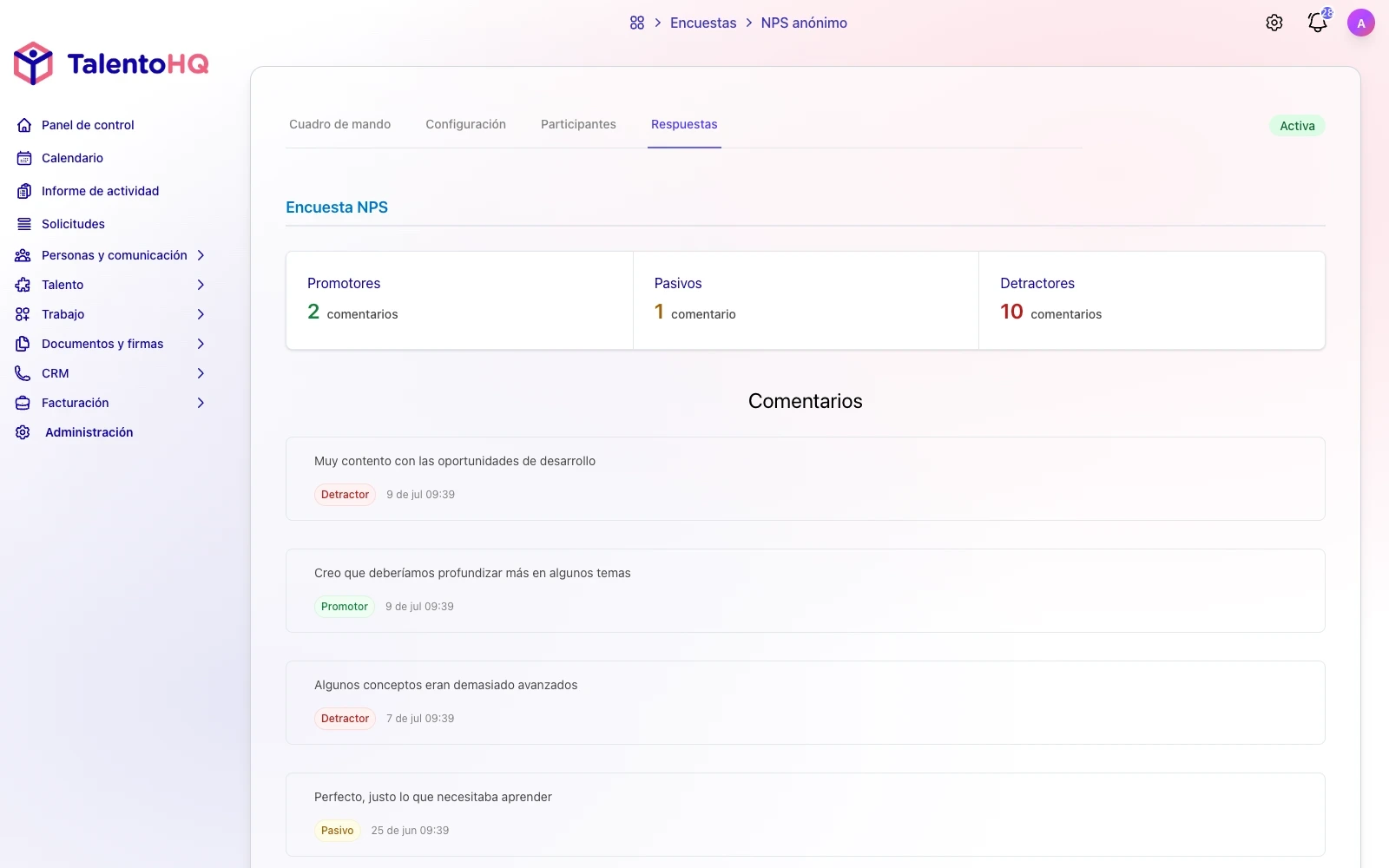
The dashboard shows:
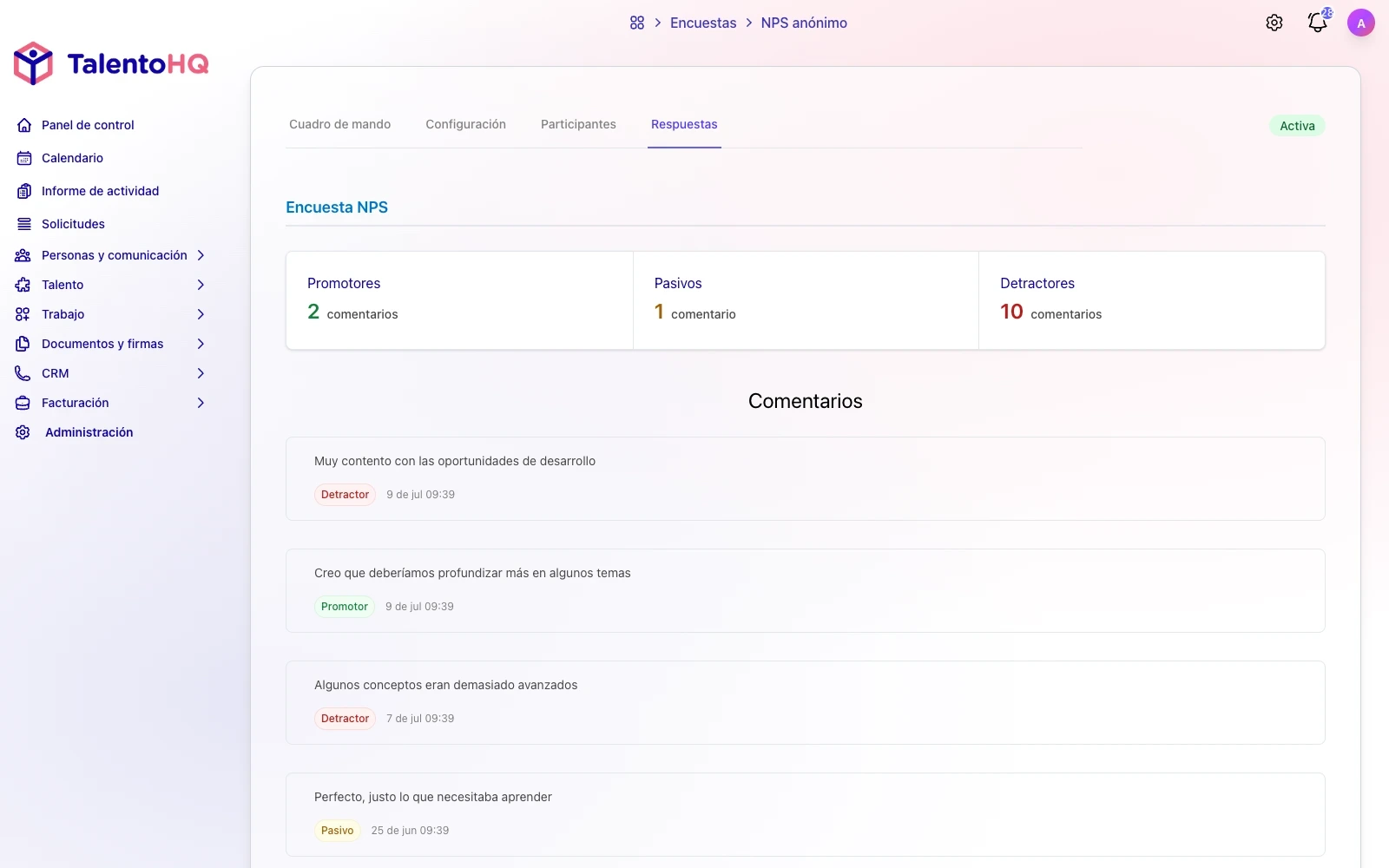
- NPS evolution.
- Distribution of promoters, passives, and detractors.
- Text comments from participants.
Visual example:
5.3. Integration with other features
Results can be connected to other tools like training, performance reviews, or employee engagement surveys.
6. Best practices for using NPS with TalentoHQ
- Define a clear objective for each survey.
- Don't overwhelm with too many surveys to avoid fatigue.
- Analyze both the numbers and the comments.
- Act quickly on detected issues.
Evolution chart:
7. Real-world usage examples
Internal case:
A tech company launches an NPS survey after implementing remote work. The NPS goes up by 20% thanks to improved work-life balance and flexibility.
External case:
A winery uses anonymous NPS surveys after visits to their facilities. The data helped them optimize both the duration and routes of the tours.
Dashboard - TalentoHQ:
8. Statistics that support the use of NPS
- Promoters are 4-5 times more likely to repurchase.
- A 10-point NPS increase can lead to a 2% increase in annual revenue.
- 70% of leading companies in customer experience use NPS as a key indicator.
Key fact: A 10-point increase in NPS can correlate with a 2% increase in annual revenue.
9. Turning data into concrete actions
With TalentoHQ, companies can:
- Segment results by department, product, or region.
- Export data for deeper analysis.
- Link surveys to specific action/training plans.
10. Conclusion
NPS surveys are a powerful tool for listening, understanding, and improving.
TalentoHQ lets you make the most of this system thanks to its ease of use, the ability to create unlimited and anonymous surveys, and its integration with your broader HR and customer management tools.
With TalentoHQ, every opinion counts and every data point becomes an opportunity for improvement. Request a no-commitment demo