Your company has passed 50 employees, and someone asks whether its equality plan has been negotiated and registered. If the answer is still “we are collecting data,” the gap is not merely administrative. In Spain, an equality plan can be a legal requirement, with a regulated diagnosis, negotiation, content, registration, and monitoring process.
This English-language guide is for employers operating in Spain. It explains the approved Spanish source as a practical overview; it is not a guide to US employment law and does not replace advice on your workforce, collective agreement, or negotiating circumstances.
What an equality plan is and who must have one
An equality plan is an ordered set of measures adopted after a diagnosis of the company's situation. Its purpose is to achieve equal treatment and opportunity for women and men and to eliminate sex-based discrimination.
The framework is set out in Spain's Organic Law 3/2007 and developed by Royal Decree 901/2020. A plan is required for companies with 50 or more employees. A smaller company may also be required by its collective agreement or as part of a labor-authority sanction.
Workforce counting has specific statutory rules, including the treatment of different contract types and certain former temporary contracts. The count must be checked on the regulated dates, and reaching the threshold starts a negotiation obligation. Under the approved Spanish source, the obligation continues once triggered even if headcount later falls, for the period established by the plan or up to the regulatory maximum.
Do not rely on a dashboard headline or the current payroll list alone. Confirm the calculation and timeline with an adviser who can apply the rules to the company.
Minimum content of an equality plan
The plan starts with a negotiated diagnosis based on workforce data broken down by sex. The regulated areas include recruitment and hiring, job classification, training, promotion, working conditions, shared responsibility for personal and family rights, women's underrepresentation, remuneration, and prevention of sexual and sex-based harassment.
The final document identifies the parties and scope, presents the diagnosis, defines qualitative and quantitative objectives, sets measures and priorities, assigns resources and owners, establishes a schedule, and creates monitoring, evaluation, and revision procedures.
The pay audit and salary register
The equality plan must include the pay-audit work required by Royal Decree 902/2020. This involves an assessment of jobs and an analysis of pay information to identify and address unjustified differences.
The equality-plan process is distinct from the salary register, which applies more broadly to companies. Where the regulated calculation shows an average pay difference of 25% or more between sexes in the relevant context, the company must include the required justification. A percentage does not by itself determine discrimination, and an explanation cannot be treated as a substitute for analysis.
Measures, deadlines, and indicators
“Improve work-life balance” is not an operational measure. A useful plan states what will change, who owns the work, when it will happen, which resources are assigned, and how progress will be measured.
For example, if the diagnosis shows unequal use of care-related leave, a measure might include clear information for the full workforce, manager training, a defined schedule, and indicators that track requests and participation without penalizing employees.
How the plan is negotiated and registered
An equality plan is not a policy HR can normally write and impose on its own. It is negotiated with the employee representatives through the committee required by the regulation. When there is no legal employee representation, the rules provide for participation by the relevant unions through the procedure set out in Royal Decree 901/2020.
The approved Spanish source notes that the employer should document invitations and responses when forming the committee, including the applicable response window. Because representation and committee formation are legally sensitive, obtain advice before concluding that the company may proceed after silence or without all expected participants.
The plan must be registered in Spain's REGCON system whether compulsory or voluntary and whether or not the negotiation concluded with agreement. Registration does not turn a weak diagnosis into an effective plan; implementation and monitoring remain essential.
Consequences of not having the required plan
Failure to prepare or apply a required equality plan may be treated as a serious or very serious employment-law violation under Spain's LISOS framework. The approved Spanish source gives ranges from €751 to €7,500 for serious infringements and up to €225,018 for very serious cases, depending on the facts and classification.
Other consequences may include exclusion from certain public contracts, loss of employment-related benefits, corrective orders, litigation risk, and reputational harm. A company should not infer an exact penalty from this summary; enforcement depends on the conduct and current law.
How an SME can approach the plan methodically
1. Confirm the obligation and establish the committee
Validate headcount, the applicable collective agreement, any prior administrative decision, and the negotiating parties. Record the steps used to constitute the committee.
2. Prepare dependable workforce and pay data
Clean employee, contract, job, classification, promotion, training, leave, and remuneration information. Agree definitions before comparing groups.
3. Negotiate the diagnosis and concrete measures
Use the findings to set priorities, owners, resources, deadlines, and indicators. Preserve committee minutes and the reasoning behind decisions.
4. Register, communicate, monitor, and revise
Register the completed plan, make the relevant information available, and follow the agreed evaluation calendar. Under the Spanish framework summarized by the source, validity cannot exceed four years. Annual operational follow-up can help identify problems before the intermediate and final evaluations.
How TalentoHQ supports equality-plan preparation
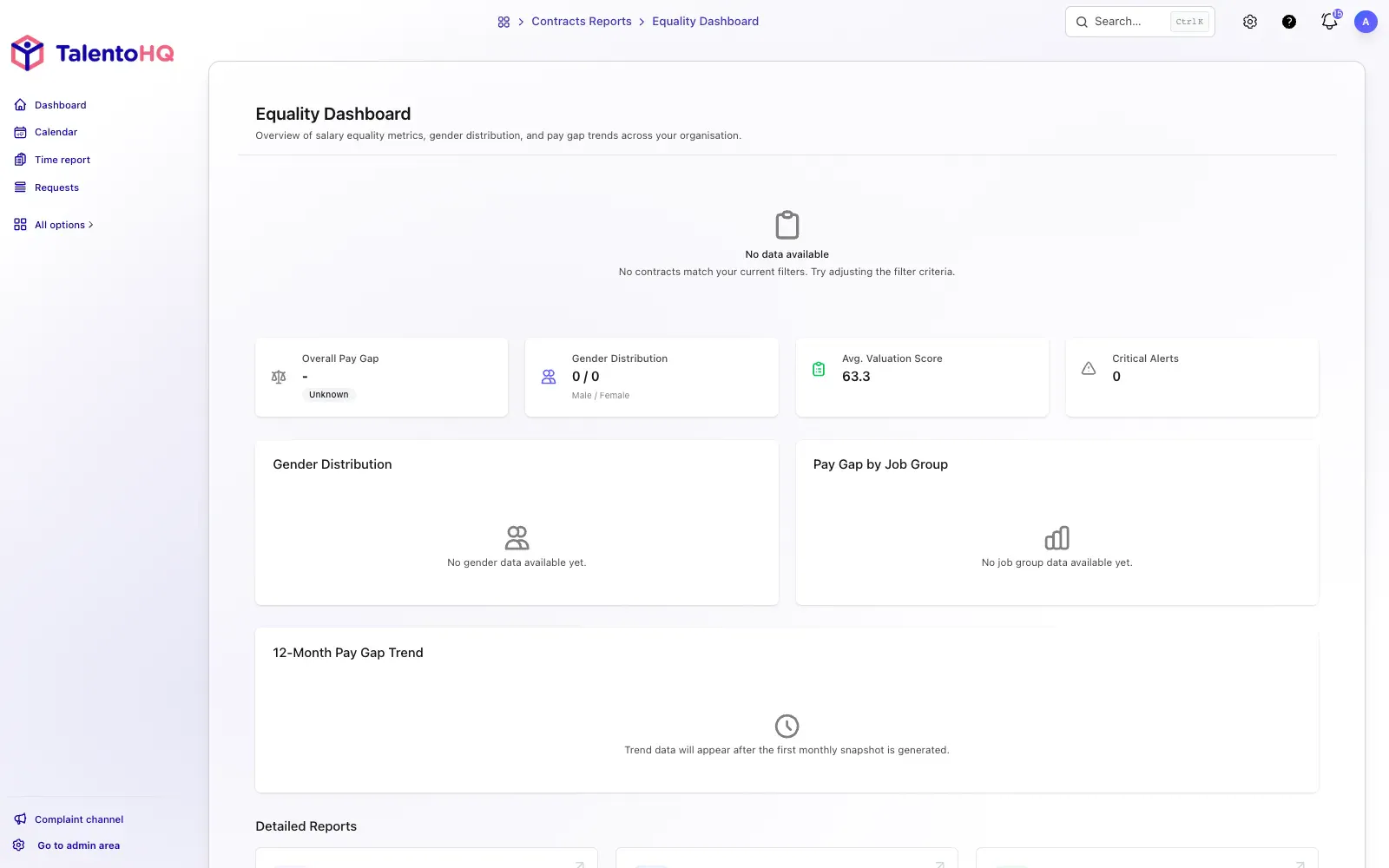
The difficult part is often not writing a policy paragraph but obtaining consistent data. TalentoHQ can organize employee attributes, job and organizational information, pay data, documents, training, surveys, and reports so authorized participants can work from a controlled source.
Organized data for diagnosis and pay review
Employee records and reporting filters can support analysis by relevant workforce dimensions. The pay-equality feature helps organize salary-register, job-evaluation, and gap-analysis work. The company and its advisers must still validate the methodology, lawful data use, comparisons, and conclusions.
Distribution, training, and follow-up
Approved documents can be distributed through the employee portal, with acknowledgment or signature workflows where configured. Training can be assigned, climate or experience surveys can gather input, and responsible teams can use reports and recurring tasks to follow measures.
These functions provide coordination and evidence. They do not conduct the negotiation, certify the plan, guarantee registration, or replace the monitoring committee.
Beyond the obligation: what workforce data can reveal
A strong equality-plan process can show where recruitment pipelines narrow, whether access to training or promotion differs, how care-related measures are used, and whether pay differences require further investigation. That information is useful only if definitions are consistent and the company is willing to act on the results.
For an SME, the practical lesson is to build the data foundation before the deadline becomes urgent. Confirm the legal scope, negotiate properly, choose measurable actions, and keep the plan connected to everyday decisions rather than treating it as a PDF stored after registration.