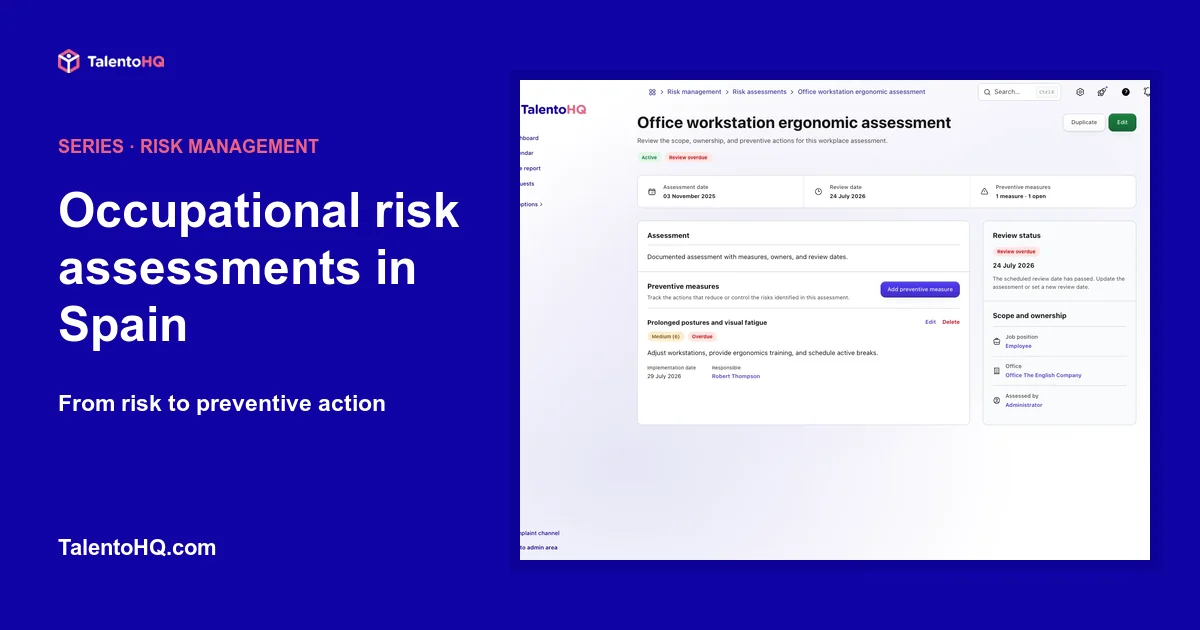
An occupational risk assessment improves working conditions only when it leads to specific decisions. Identifying a risk is the beginning. The company must then define measures, set priorities, assign owners, and check whether those measures were implemented.
The work is to preserve that path without confusing the record with technical judgment. TalentoHQ documents decisions, but qualified professionals perform the assessment under Spain's occupational risk prevention framework.
What is an occupational risk assessment?
Article 16 of Spain's Law 31/1995 requires prevention to be integrated through a plan, risk assessment, and planning of preventive activity. The assessment identifies risks that could not be avoided and provides the information needed to decide on measures.
The assessment must reflect the real conditions of each position, location, item of equipment, and exposed group. One identical template for the whole company cannot capture those differences. The analysis needs another review when conditions change or the measures prove insufficient.
The INSST guidelines describe assessment and planning as essential tools for integrating occupational risk prevention. The technical conclusion and the audit trail of the resulting actions should therefore remain connected.
From identified risk to preventive planning
A useful preventive measure must be specific enough for another person to understand what will happen. “Improve ergonomics” states an intention. “Adjust workstations, review monitors, and schedule training by September 30” provides a verifiable basis.
For each risk, record:
- Identified risk. The situation that can cause harm and the context in which it occurs.
- Agreed measure. The action intended to eliminate, reduce, or control the risk.
- Priority. The urgency arising from the scale of the risk and the people exposed.
- Owner. The person who will coordinate or verify implementation.
- Date. A realistic deadline, including interim measures when needed.
- Status. Pending, in progress, or complete, supported by sufficient evidence.
Spain's Prevention Services Regulation states that planning must establish phases, priorities, resources, and follow-up. The administrative record preserves that information and documents progress. Changing a label does not complete the action.
How to set priorities without treating the matrix as absolute
Many organizations combine severity and likelihood to order risks. This is a supporting tool: it makes the criteria explicit and helps compare measures, but it does not replace specific methods, measurements, or sector requirements.
In TalentoHQ, each value is recorded on a scale from 1 to 5. The system multiplies severity by likelihood and displays four levels:
- Low: score from 1 to 4.
- Medium: score from 5 to 9.
- High: score from 10 to 15.
- Critical: score from 16 to 25.
The classification helps order the work, but it must be interpreted through the applicable prevention method. Two risks with the same score can require different decisions because of exposure, specific regulations, or the potential for serious harm.
Create the assessment in TalentoHQ
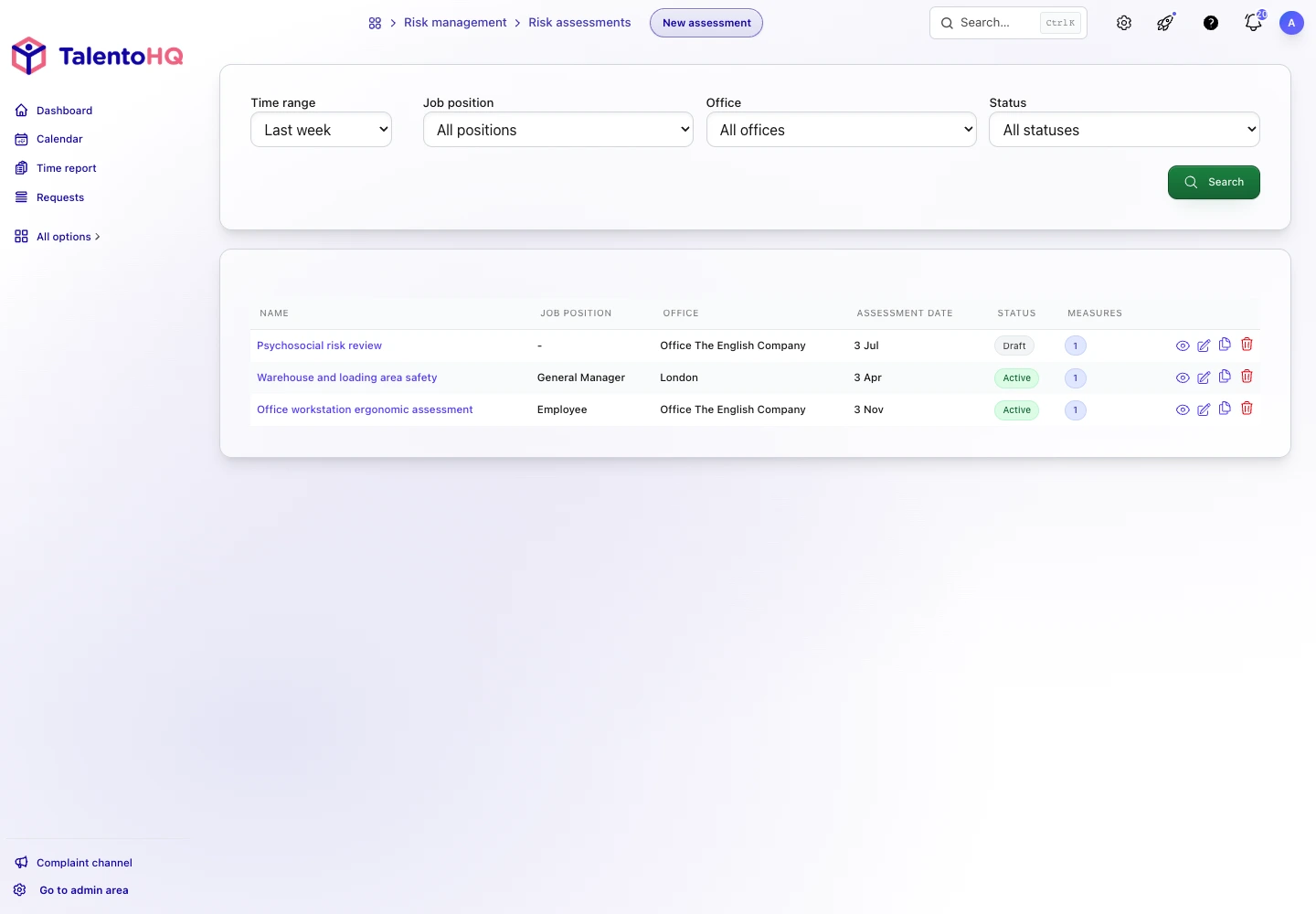
The assessment record includes a recognizable name, date, assessor, and status. It can also be linked to a position and office, include a description, set the next review, and attach authorized files.
Statuses organize the document's life cycle:
- Draft. The assessment is being prepared or reviewed.
- Active. It is the current assessment the company uses as its reference.
- Archived. It is retained as history without being presented as current.
Status and review date are independent. If a draft or archived assessment retains a review date that has arrived, the dashboard will show it as needing attention. This prevents a pending date from disappearing when a record is archived or left in draft, but the data must be reviewed so it continues to represent reality.
Assign and track preventive measures
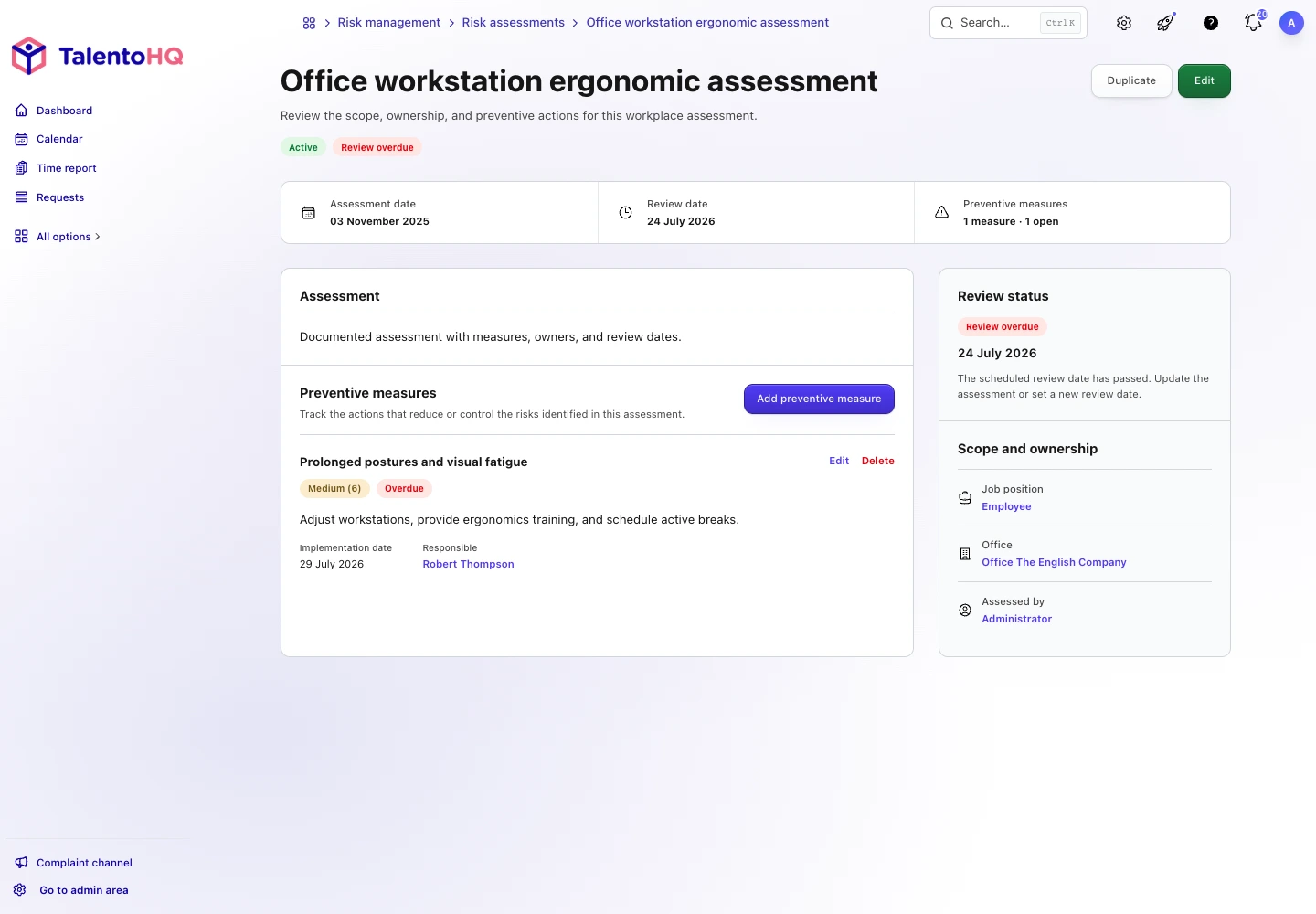
Within each assessment, create one measure for each risk or action that needs follow-up. The identified risk and description are required. Severity, likelihood, owner, and date can be completed when applicable.
A pending or in-progress measure appears as overdue after its implementation date passes. “Overdue” is a calculated signal: the saved status remains pending or in progress until someone records what happened.
Reaching the deadline does not complete an action. If the measure was implemented, update it with evidence. If it remains open, review the cause, owner, priority, and new plan.
To see how assessment, owner, and measure connect in a sample account, you can request a demo with no commitment.
Duplicate an assessment without copying old decisions
When a periodic assessment starts with a similar scope, duplication reduces administrative work. TalentoHQ creates a new assessment with today's date, draft status, and a name marked as a copy. It copies the measures and resets them to pending.
It also retains data that needs review: the next assessment date, owners, implementation dates, and ratings. Compare each one with current conditions before activating the copy.
A sound review of the copy includes these steps:
- Confirm that the position, office, and scope remain correct.
- Check for changes in processes, equipment, materials, or exposed people.
- Reassess severity and likelihood through the applicable method.
- Remove measures that no longer apply and add new ones.
- Assign current owners and dates.
- Obtain technical validation before marking the assessment active.
Review the dashboard without removing context from alerts
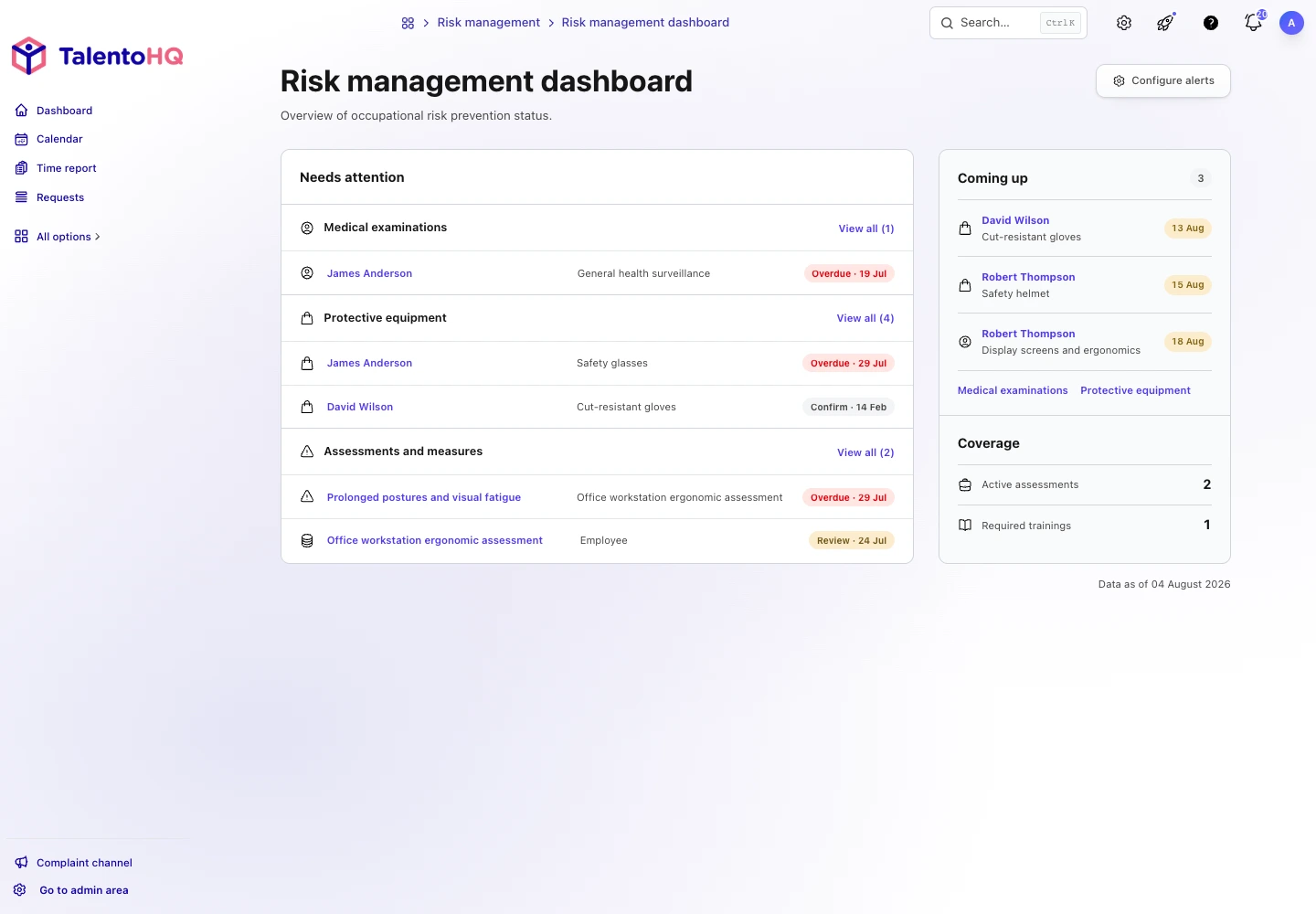
The occupational risk dashboard groups assessments whose review date is today or earlier and open measures that have passed their date. It displays a prioritized selection and links to the full lists.
The signal does not determine the response on its own. An overdue review may require a new assessment, correction of a date that no longer reflects the agreed schedule, or documentation of a review that already took place. An overdue measure may need resources, a new owner, or an interim action.
The guide to occupational risk alerts and deadlines explains how to turn this dashboard into a recurring routine. For the wider module context, see the occupational risk management guide for Spanish SMEs.
Common mistakes when documenting assessments
- Using a generic title. “2026 assessment” makes scope and version difficult to identify; include the position, office, or activity.
- Creating a measure with no verifiable outcome. The description should make the intended implementation clear.
- Assigning an abstract department. One named owner makes follow-up easier, even when a team participates.
- Marking work complete without evidence. The status must reflect a real, reviewed action.
- Keeping inherited dates after duplication. Each copy needs a full review before activation.
- Reading the score outside the technical method. The matrix supports prioritization; it is not a universal assessment.
A practical example: from risk to measure
An office-position assessment identifies sustained postures and eye strain. The technical conclusion may require a review of furniture and monitors, adjustments to break arrangements, corrected lighting, and training on proper workstation use. Reducing the response to “provide a course” would leave part of the risk untreated.
In the record, each action can be a separate measure when it has its own owner or deadline. Operations might own the monitor review, administration the workstation changes, and the prevention and HR teams the training. Separating them allows progress to be checked without marking the entire risk resolved after only one part is complete.
After implementing the measures, the organization needs to verify their effectiveness. If exposure remains or new conditions emerge, review the assessment again. The completion date documents an action; it does not replace that check.
Frequently asked questions about assessments and measures
Can an assessment cover a position and an office?
Yes. TalentoHQ lets you associate both fields when they represent the scope. They can remain blank when the assessment covers another context, but the name and description should make its application clear.
When is a measure overdue?
When it remains pending or in progress after its implementation date. Overdue is a calculated signal; it does not replace the saved status or explain why the action was not completed.
Should the previous assessment be archived?
When a new version becomes the current reference, archiving the previous one helps distinguish current work from history. First review open measures, documents, and relationships so tasks that still need follow-up are not lost.
Does duplication renew an assessment?
No. The function creates a draft that reuses the structure and measures. Technical work to observe conditions, evaluate risks, and decide on actions remains necessary.
What happens when the owner changes?
Reassign the measure and give the new owner its context, deadline, and expected evidence. Changing the name is not enough; the handoff must be part of follow-up.
This review is also an opportunity to confirm whether the deadline remains realistic and whether enough resources are available to complete the action.
Conclusion: close measures with evidence
An occupational risk assessment needs understandable measures, named owners, realistic deadlines, and a way to verify the result. TalentoHQ retains the assessment, its versions, and open measures. Professional analysis determines what must be done and whether it worked.
Continue the series with occupational medical examination tracking, or see the complete occupational risk management map for Spanish SMEs.