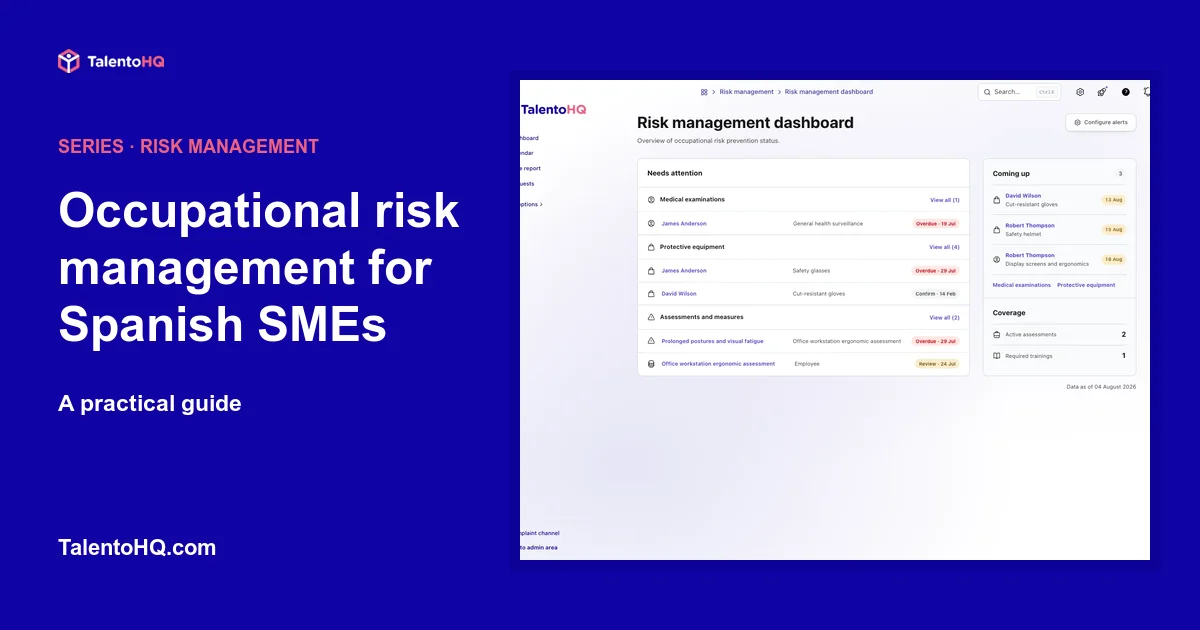
Filing a risk assessment does not complete occupational risk management for a small or midsize company in Spain. Prevention continues as the company decides on measures, assigns owners, reviews dates, and keeps evidence of what it has done.
When health protocols, occupational medical examinations, personal protective equipment (PPE) issue records, assessments, measures, and training sit in different places, a basic question becomes difficult to answer: what needs attention today?
Well-organized occupational risk management for Spanish SMEs connects that technical work with administrative follow-up. TalentoHQ brings the records together without replacing the judgment of the occupational risk prevention service or qualified professionals.
Prevention is an ongoing process
Spain's Law 31/1995 on Occupational Risk Prevention makes worker health and safety part of company management. Risk assessment and preventive planning must inform decisions, job changes, and day-to-day operations.
The Spanish National Institute for Safety and Health at Work (INSST) guidelines on risk assessment also treat assessment and planning as connected tools. Identifying a risk creates value when it leads to an appropriate measure with a priority, an owner, and a later check.
For an SME in Spain, this approach can be framed through five management questions:
- Scope. Which positions, offices, activities, and people are included?
- Action. Which measures have been agreed, and who must implement them?
- Follow-up. Which examinations, equipment issues, or reviews have an upcoming date?
- Evidence. Where is each action documented without collecting unnecessary information?
- Review. Which changes require another check of the assessment, training, or equipment?
Who takes part in prevention management
The employer's responsibility cannot be delegated, although day-to-day management is usually shared. Senior management provides resources and approves priorities; the prevention service performs or advises on technical work; HR maintains certain records; team managers communicate changes and check actions; and employees participate and report working conditions.
Technical and administrative responsibilities need clear boundaries. Recording an assessment in a system does not mean the assessment has been performed, and marking a measure complete does not prove that it is effective. The tool preserves structure, dates, and owners. People with the required expertise and information make the prevention decisions.
A simple responsibility matrix helps remove gray areas:
- Occupational risk prevention service. Assesses risks and proposes technical criteria.
- Senior management. Decides on resources, priorities, and the implementation schedule.
- HR or administration. Records fitness conclusions, dates, equipment issues, and authorized documents.
- Operational managers. Implement or supervise measures in their area.
- Employees. Receive information and training, use the available equipment, and report incidents.
Six parts of an organized prevention system
A useful system connects records with different purposes without forcing every prevention activity into one form.
- Risk assessments. Define the position or office, date, assessor, status, and next review.
- Preventive measures. Turn identified risks into actions, owners, dates, and implementation statuses.
- Protocols and medical examinations. Organize occupational health surveillance while retaining only the information the company is entitled to know.
- PPE issues. Record the item, recipient, quantity, date, expiration, and acknowledgment of receipt.
- Prevention training. Connect job requirements with courses, sessions, participants, and renewals.
- Dashboard and follow-up. Bring expirations and reviews together so the team can decide what to address first.
Each part has its own purpose and guide in this series. Read more about risk assessments and preventive measures, occupational medical examination tracking, PPE issue records, occupational risk alerts and reviews, and occupational risk prevention training.
A monthly routine that does not depend on memory
The exact frequency must reflect the risks and the organization, but a monthly administrative review is a reasonable starting point. It checks whether documented commitments are moving forward between technical work and extraordinary reviews.
The meeting can take 30 minutes when it follows a stable list:
- Review examinations whose next date has arrived or is approaching.
- Check PPE issues that have expired, will expire soon, or lack an acknowledgment.
- Open assessments whose review date has arrived.
- Review pending or in-progress measures that have passed their implementation date.
- Confirm which prevention courses are configured and where participation is reviewed.
- Record completed actions and assign owners to work that remains open.
Changing dates to clear the dashboard destroys the value of follow-up. If an item is overdue, review the real-world action first, then update the record so it reflects what happened.
How TalentoHQ organizes occupational risk management
TalentoHQ brings these workflows into a space available to people with the appropriate module and permissions. Records linked to employees respect the group of people each manager is authorized to manage, so work can be distributed without opening information to the entire organization.
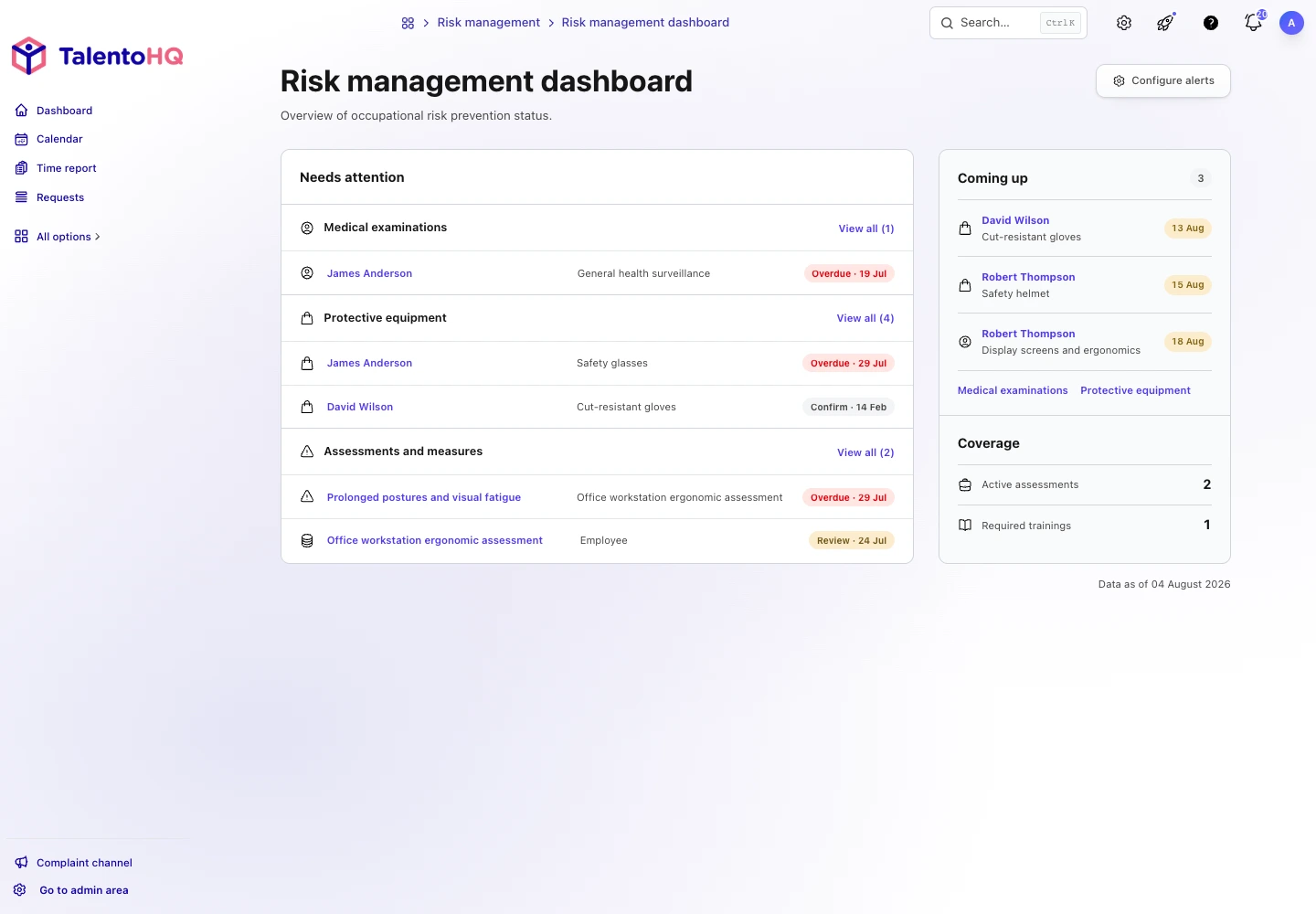
The dashboard groups information into three areas:
- Needs attention. Includes overdue medical examinations, expired PPE or issues without a recorded acknowledgment, assessments whose review date has arrived, and overdue measures that remain open.
- Coming up. Shows medical examinations and PPE expirations within the next 30 days.
- Coverage. Summarizes the number of active assessments and courses marked as required for occupational risk prevention.
Coverage measures the number of configured records; it is not a compliance certification. A course counted on the dashboard can still have participants who have not completed it. An active assessment can still contain incomplete measures. A sound review always combines the count with the underlying details.
If you would like to review this process with data similar to your company's, you can request a personalized demo with no commitment.
From assessment to evidence
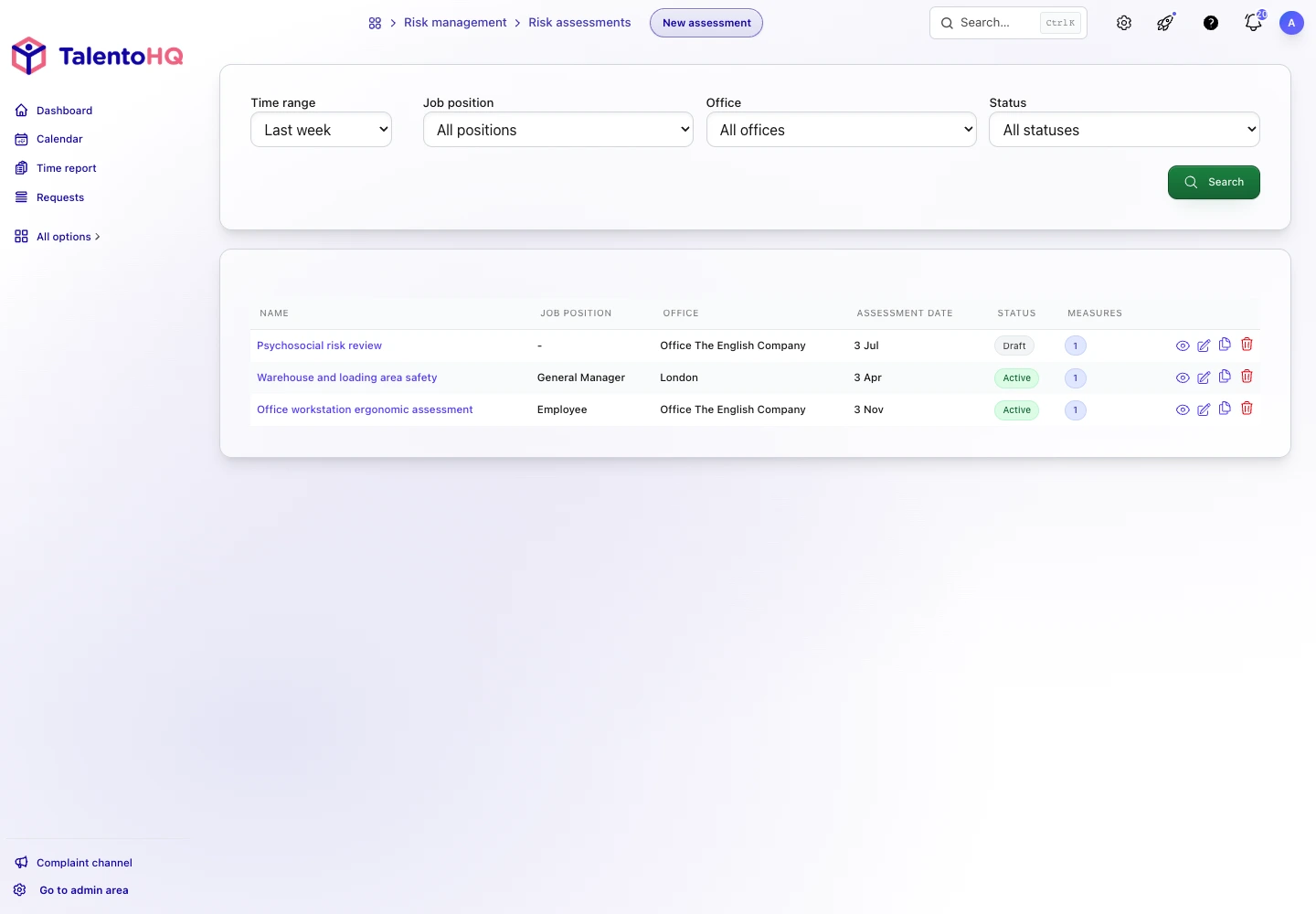
After an assessment is created, measures can record the identified risk, the agreed action, its owner, and the implementation date. Severity and likelihood can provide an indicative classification within the record and help order the follow-up.
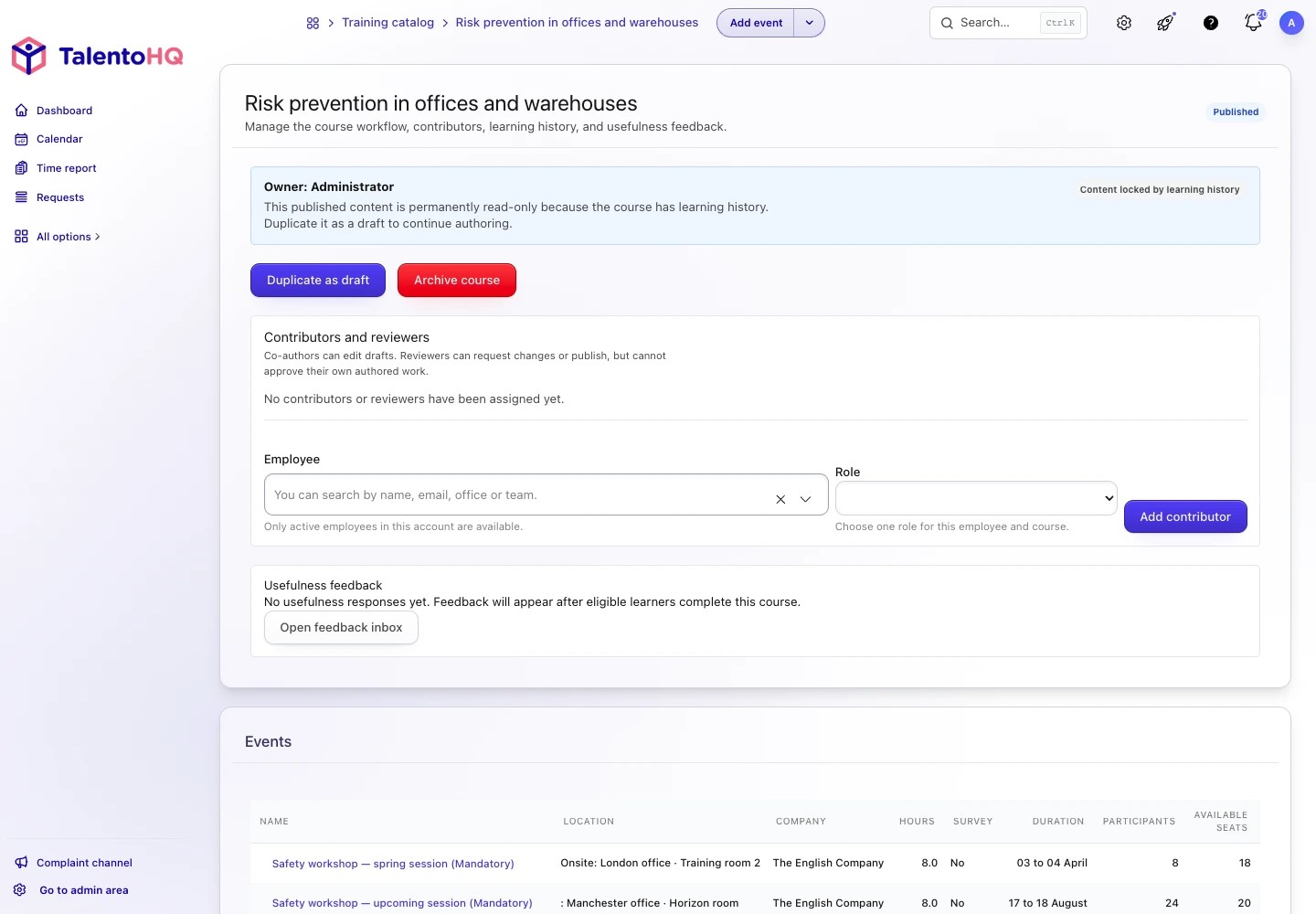
Medical examination records retain the type, prevention-related conclusion, protocol, and next date. PPE issues add the item, quantity, expiration, and acknowledgment status. Training is managed in its own area, where content, events, and participants are organized, while the occupational risk dashboard counts courses marked as required.
This separation prevents the occupational risk record from becoming an unstructured folder. Each data point has a purpose and can be reviewed in the workflow where it is used.
Mistakes that reduce the system's value
- Confusing a record with compliance. Software documents work; it does not certify that a measure is technically sufficient.
- Storing excessive medical data. The company usually needs the fitness conclusion and follow-up information, not the full diagnosis.
- Changing dates to hide alerts. Dates should reflect the real plan, and any change should be justified.
- Failing to assign owners. A measure with no named owner depends on informal reminders.
- Duplicating assessments without reviewing them. A copy is a starting point, not proof of a new assessment.
- Treating training as a counter. Coverage shows configured courses; participation is checked in Training.
How to implement the system in stages
Trying to load the entire history in one week can displace the main goal: managing current work better. A gradual implementation lets the company validate owners, permissions, and criteria before expanding the scope.
The first stage can focus on current information: active assessments, open measures, upcoming medical examinations, and PPE now in use. The second adds protocols, the item catalog, and required training. The third adds useful history that falls within the applicable retention period.
Each stage should include a quality review:
- Check that owners have access without receiving broader permissions than they need.
- Confirm that names, statuses, and dates follow consistent rules.
- Identify duplicate attachments or sensitive information that should not be migrated.
- Compare a sample with original sources and the occupational risk prevention service.
- Explain to managers and administrators which task belongs on each screen.
Migration should not turn old documents into data that appears current. If a date or owner is unknown, it is better to leave the field blank and document the pending review.
Frequently asked questions about occupational risk management
Can an SME perform its own risk assessment?
It depends on the prevention arrangement, the activity, and the expertise required under Spanish law. The tool does not determine who is qualified. The company must confirm its prevention organization and seek specialist advice when the technical complexity requires it.
Must every document be recorded?
No. The company should retain the records required by Spanish law and its own procedure, with particular care around health data. Centralizing information does not mean copying the entire prevention archive without judgment.
What should be reviewed after a job change?
Review the applicable assessment, measures, required training, PPE, and, when relevant, health surveillance protocols. The change should start a coordinated review, not merely update the job title in the employee record.
Does the dashboard replace follow-up meetings?
No. It reduces the work required to collect dates and statuses, but decisions need context. The dashboard prepares the discussion; managers and prevention professionals decide on the action and record the result.
Conclusion: decide what to review, who will act, and when
Occupational risk management for Spanish SMEs depends on a specific routine: every assessment leads to measures, every measure has an owner and a date, and medical examinations, PPE, and training are reviewed against defined criteria.
TalentoHQ documents dates, statuses, owners, and authorized evidence. The next monthly review should end with a short list of actions, one owner for each action, and a date for checking the result.